Application
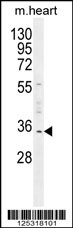
UPP2 Antibody (C-term) western blot analysis in mouse heart tissue lysates (35ug/lane).This demonstrates the UPP2 antibody detected the UPP2 protein (arrow).Application
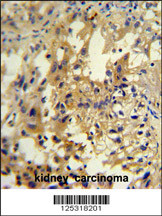
UPP2 antibody (C-term) immunohistochemistry analysis in formalin fixed and paraffin embedded human kidney carcinoma followed by peroxidase conjugation of the secondary antibody and DAB staining. This data demonstrates the use of the UPP2 antibody (C-term) for immunohistochemistry. Clinical relevance has not been evaluated.| Product Name | UPP2 Antibody (C-term) |
|---|---|
| Antibody Type | Primary Antibodies |
| Antigen Alias | UPP2; Uridine phosphorylase 2 |
| Clonality | Polyclonal |
|---|---|
| Isotype | Ig |
| Host Species | Rabbit |
| Tested Applications | WBIHC |
| WB:1:100~500 IHC |
|
| Species Reactivity | Human |
| Concentration | 1mg/ml |
| Alternative Names | UPP2 Uridine phosphorylase 2 |
|---|---|
| Molecular Weight(MW) | 35527 Da |
| Function | Catalyzes the reversible phosphorylytic cleavage of uridine and deoxyuridine to uracil and ribose- or deoxyribose-1- phosphate. The produced molecules are then utilized as carbon and energy sources or in the rescue of pyrimidine bases for nucleotide synthesis. Shows substrate specificity and accept uridine, deoxyuridine, and thymidine as well as the two pyrimidine nucleoside analogs 5-fluorouridine and 5-fluoro-2(')-deoxyuridine as substrates |
| Tissue Specificity | Predominantly expressed in kidney. |
| Entrez Gene | 151531 |
|---|---|
| Nucleotide Accession | NP_001128570.1 NP_775491.1 |
Application
UPP2 Antibody (C-term) western blot analysis in mouse heart tissue lysates (35ug/lane).This demonstrates the UPP2 antibody detected the UPP2 protein (arrow).
Application
UPP2 antibody (C-term) immunohistochemistry analysis in formalin fixed and paraffin embedded human kidney carcinoma followed by peroxidase conjugation of the secondary antibody and DAB staining. This data demonstrates the use of the UPP2 antibody (C-term) for immunohistochemistry. Clinical relevance has not been evaluated.| Application Notes | WB:1:100~500 IHC |
|---|
| Form | Liquid |
|---|---|
| Storage Instructions | For short-term storage, store at 4° C. For long-term storage, aliquot and store at -20ºC or below. Avoid multiple freeze-thaw cycles. |
| Storage Buffer | Purified polyclonal antibody supplied in PBS with 0.09% (W/V) sodium azide. This antibody is purified through a protein A column, followed by peptide affinity purification. |


