Application
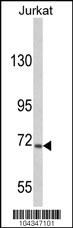
Western blot analysis of hUSP19-L1304 in Jurkat cell line lysates (35ug/lane). USP19 (arrow) was detected using the purified Pab.| Product Name | USP19 Antibody (C-term) |
|---|---|
| Antibody Type | Primary Antibodies |
| Clonality | Polyclonal |
|---|---|
| Isotype | Ig |
| Host Species | Rabbit |
| Tested Applications | WB |
| WB:1:50~100 |
|
| Species Reactivity | Human |
| Concentration | 1mg/ml |
| Gene Synonyms | KIAA0891, ZMYND9 |
|---|---|
| Alternative Names | USP19 KIAA0891 ZMYND9 Ubiquitin carboxyl-terminal hydrolase 19 Deubiquitinating enzyme 19 Ubiquitin thioesterase 19 Ubiquitin-specific-processing protease 19 Zinc finger MYND domain-containing protein 9 |
| Molecular Weight(MW) | 145651 Da |
| Function | Deubiquitinating enzyme that regulates the degradation of various proteins. Deubiquitinates and prevents proteasomal degradation of RNF123 which in turn stimulates CDKN1B ubiquitin- dependent degradation thereby playing a role in cell proliferation. Involved in decreased protein synthesis in atrophying skeletal muscle. Modulates transcription of major myofibrillar proteins. Also involved in turnover of endoplasmic- reticulum-associated degradation (ERAD) substrates. Regulates the stability of BIRC2/c-IAP1 and BIRC3/c-IAP2 by preventing their ubiquitination. Required for cells to mount an appropriate response to hypoxia and rescues HIF1A from degradation in a non- catalytic manner. Plays an important role in 17 beta-estradiol (E2)-inhibited myogenesis. Decreases the levels of ubiquitinated proteins during skeletal muscle formation and acts to repress myogenesis. Exhibits a preference towards 'Lys-63'-linked Ubiquitin chains |
| Tissue Specificity | This USP19 antibody is generated from rabbits immunized with a KLH conjugated synthetic peptide between 1290~1319 amino acids from the C-terminal region of human USP19. |
| Cellular Localization | Endoplasmic reticulum membrane; Single-pass membrane protein |
Application
Western blot analysis of hUSP19-L1304 in Jurkat cell line lysates (35ug/lane). USP19 (arrow) was detected using the purified Pab.| Application Notes | WB:1:50~100 |
|---|
| Form | Liquid |
|---|---|
| Storage Instructions | For short-term storage, store at 4° C. For long-term storage, aliquot and store at -20ºC or below. Avoid multiple freeze-thaw cycles. |
| Storage Buffer | Purified polyclonal antibody supplied in PBS with 0.09% (W/V) sodium azide. This antibody is purified through a protein G column, eluted with high and low pH buffers and neutralized immediately, followed by dialysis against PBS. |


