Application
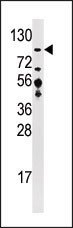
Western blot analysis of anti-VDU1 Pab in T47D cell line lysate (35ug/lane). VDU1(arrow) was detected using the purified Pab.| Product Name | VDU1 Antibody (C-term) |
|---|---|
| Antibody Type | Primary Antibodies |
| Clonality | Polyclonal |
|---|---|
| Isotype | Ig |
| Host Species | Rabbit |
| Tested Applications | WB |
| WB:1:100~500 |
|
| Species Reactivity | Human |
| Concentration | 1mg/ml |
| Gene Synonyms | KIAA1097, VDU1 |
|---|---|
| Alternative Names | USP33 KIAA1097 VDU1 Ubiquitin carboxyl-terminal hydrolase 33 Deubiquitinating enzyme 33 Ubiquitin thioesterase 33 Ubiquitin-specific-processing protease 33 VHL-interacting deubiquitinating enzyme 1 |
| Molecular Weight(MW) | 106727 Da |
| Function | Deubiquitinating enzyme involved in various processes such as cellular migration and beta-2 adrenergic receptor/ADRB2 recycling. Involved in cell migration via its interaction with intracellular domain of ROBO1, leading to regulate the Slit signaling. Plays a role in commissural axon guidance cross the ventral midline of the neural tube in a Slit-dependent manner, possibly by mediating the deubiquitination of ROBO1. Acts as a regulator of G-protein coupled receptor (GPCR) signaling by mediating the deubiquitination of beta-arrestins (ARRB1 and ARRB2) and beta-2 adrenergic receptor (ADRB2). Plays a central role in ADRB2 recycling and resensitization after prolonged agonist stimulation by constitutively binding ADRB2, mediating deubiquitination of ADRB2 and inhibiting lysosomal trafficking of ADRB2. Upon dissociation, it is probably transferred to the translocated beta-arrestins, leading to beta-arrestins deubiquitination and disengagement from ADRB2. This suggests the existence of a dynamic exchange between the ADRB2 and beta- arrestins. Deubiquitinates DIO2, thereby regulating thyroid hormone regulation. Mediates deubiquitination of both 'Lys-48'- and 'Lys-63'-linked polyubiquitin chains |
| Tissue Specificity | Widely expressed. |
| Cellular Localization | Cytoplasm, perinuclear region. Note=According to PubMed:12865408, it localizes in the endoplasmic reticulum; however the relevance of such result is unclear |
Application
Western blot analysis of anti-VDU1 Pab in T47D cell line lysate (35ug/lane). VDU1(arrow) was detected using the purified Pab.| Application Notes | WB:1:100~500 |
|---|
| Form | Liquid |
|---|---|
| Storage Instructions | For short-term storage, store at 4° C. For long-term storage, aliquot and store at -20ºC or below. Avoid multiple freeze-thaw cycles. |
| Storage Buffer | Purified polyclonal antibody supplied in PBS with 0.09% (W/V) sodium azide. This antibody is purified through a protein G column, eluted with high and low pH buffers and neutralized immediately, followed by dialysis against PBS. |


