Application
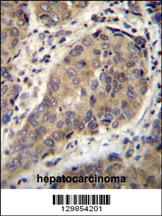
WTIP Antibody (C-term) immunohistochemistry analysis in formalin fixed and paraffin embedded human hepatocarcinoma followed by peroxidase conjugation of the secondary antibody and DAB staining.This data demonstrates the use of WTIP Antibody (C-term) for immunohistochemistry. Clinical relevance has not been evaluated.Application
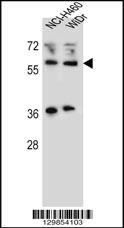
WTIP Antibody (C-term) western blot analysis in NCI-H460,WiDr cell line lysates (35ug/lane).This demonstrates the WTIP antibody detected the WTIP protein (arrow).Application
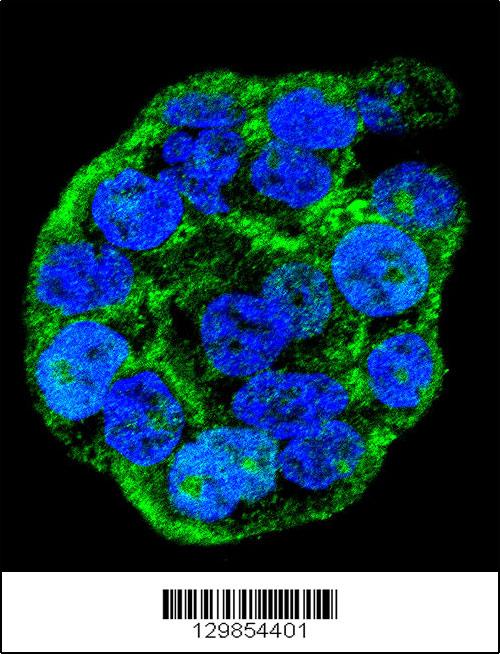
Confocal immunofluorescent analysis of WTIP Antibody (C-term)(Cat#AP11837b) with WiDr cell followed by Alexa Fluor 488-conjugated goat anti-rabbit lgG (green). DAPI was used to stain the cell nuclear (blue).| Product Name | WTIP Antibody (C-term) |
|---|---|
| Antibody Type | Primary Antibodies |
| Antigen Alias | WTIP; Wilms tumor protein 1-interacting protein |
| Clonality | Polyclonal |
|---|---|
| Isotype | Ig |
| Host Species | Rabbit |
| Tested Applications | IHCWBIF |
| IHC:1:10~50 WB |
|
| Species Reactivity | Human |
| Concentration | 1mg/ml |
| Alternative Names | WTIP Wilms tumor protein 1-interacting protein |
|---|---|
| Molecular Weight(MW) | 45124 Da |
| Function | Adapter or scaffold protein which participates in the assembly of numerous protein complexes and is involved in several cellular processes such as cell fate determination, cytoskeletal organization, repression of gene transcription, cell-cell adhesion, cell differentiation, proliferation and migration Positively regulates microRNA (miRNA)-mediated gene silencing Negatively regulates Hippo signaling pathway and antagonizes phosphorylation of YAP1. Acts as a transcriptional corepressor for SNAI1 and SNAI2/SLUG-dependent repression of E-cadherin transcription. Acts as a hypoxic regulator by bridging an association between the prolyl hydroxylases and VHL enabling efficient degradation of HIF1A. In podocytes, may play a role in the regulation of actin dynamics and/or foot process cytoarchitecture (By similarity). In the course of podocyte injury, shuttles into the nucleus and acts as a transcription regulator that represses WT1-dependent transcription regulation, thereby translating changes in slit diaphragm structure into altered gene expression and a less differentiated phenotype |
| Tissue Specificity | This WTIP antibody is generated from rabbits immunized with a KLH conjugated synthetic peptide between 474-503 amino acids from the C-terminal region of human WTIP. |
| Cellular Localization | Cell junction, adherens junction. Nucleus (By similarity). Cytoplasm, P-body. Note=Following podocyte injury, caused by treatment with LPS, puromycin aminonucleoside, ultraviolet or hydrogen peroxide, translocates from sites of cell- cell contacts into the cytosol and nucleus. The shift from cell contacts to intracellular plaques starts as early as 1 hour after LPS stimulation and intranuclear localization begins 3 hours after LPS treatment. Maximal nuclear localization is achieved 6 hours after LPS treatment. Nuclear translocation requires dynein motor activity and intact microtubule network (By similarity). Returns to cell-cell contacts 24 hours after LPS stimulation. In the presence of ROR2, localizes to the plasma membrane (By similarity) |
| Entrez Gene | 126374 |
|---|
Application
WTIP Antibody (C-term) immunohistochemistry analysis in formalin fixed and paraffin embedded human hepatocarcinoma followed by peroxidase conjugation of the secondary antibody and DAB staining.This data demonstrates the use of WTIP Antibody (C-term) for immunohistochemistry. Clinical relevance has not been evaluated.
Application
WTIP Antibody (C-term) western blot analysis in NCI-H460,WiDr cell line lysates (35ug/lane).This demonstrates the WTIP antibody detected the WTIP protein (arrow).
Application
Confocal immunofluorescent analysis of WTIP Antibody (C-term)(Cat#AP11837b) with WiDr cell followed by Alexa Fluor 488-conjugated goat anti-rabbit lgG (green). DAPI was used to stain the cell nuclear (blue).| Application Notes | IHC:1:10~50 WB |
|---|
| Form | Liquid |
|---|---|
| Storage Instructions | For short-term storage, store at 4° C. For long-term storage, aliquot and store at -20ºC or below. Avoid multiple freeze-thaw cycles. |
| Storage Buffer | Purified polyclonal antibody supplied in PBS with 0.09% (W/V) sodium azide. This antibody is purified through a protein A column, followed by peptide affinity purification. |


