Application
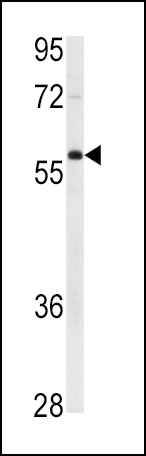
Western blot analysis of anti-BIRC4 Antibody (N-term) in Ramos cell line lysates (35ug/lane). BIRC4(arrow) was detected using the purified Pab.| Product Name | XIAP (BIRC4) Antibody (N-term) |
|---|---|
| Antibody Type | Primary Antibodies |
| Antigen Alias | XIAP; API3; BIRC4; IAP3; E3 ubiquitin-protein ligase XIAP; Baculoviral IAP repeat-containing protein 4; IAP-like protein; Inhibitor of apoptosis protein 3; X-linked inhibitor of apoptosis protein |
| Clonality | Polyclonal |
|---|---|
| Isotype | Ig |
| Host Species | Rabbit |
| Tested Applications | WB |
| WB:1:100~500 |
|
| Species Reactivity | Human |
| Concentration | 1mg/ml |
| Gene Synonyms | API3 BIRC4 IAP3 |
|---|---|
| Alternative Names | XIAP API3 BIRC4 IAP3 E3 ubiquitin-protein ligase XIAP Baculoviral IAP repeat-containing protein 4 IAP-like protein Inhibitor of apoptosis protein 3 X-linked inhibitor of apoptosis protein |
| Molecular Weight(MW) | 56685 Da |
| Function | Multi-functional protein which regulates not only caspases and apoptosis, but also modulates inflammatory signaling and immunity, copper homeostasis, mitogenic kinase signaling, cell proliferation, as well as cell invasion and metastasis. Acts as a direct caspase inhibitor. Directly bind to the active site pocket of CASP3 and CASP7 and obstructs substrate entry. Inactivates CASP9 by keeping it in a monomeric, inactive state. Acts as an E3 ubiquitin-protein ligase regulating NF-kappa-B signaling and the target proteins for its E3 ubiquitin-protein ligase activity include: RIPK1, CASP3, CASP7, CASP8, CASP9, MAP3K2/MEKK2, DIABLO/SMAC, AIFM1, CCS and BIRC5/survivin. Ubiquitinion of CCS leads to enhancement of its chaperone activity toward its physiologic target, SOD1, rather than proteasomal degradation Ubiquitinion of MAP3K2/MEKK2 and AIFM1 does not lead to proteasomal degradation. Plays a role in copper homeostasis by ubiquitinationg COMMD1 and promoting its proteasomal degradation Can also function as E3 ubiquitin-protein ligase of the NEDD8 conjugation pathway, targeting effector caspases for neddylation and inactivation. Regulates the BMP signaling pathway and the SMAD and MAP3K7/TAK1 dependent pathways leading to NF-kappa-B and JNK activation. Acts as an important regulator of innate immune signaling via regulation of Nodlike receptors (NLRs). Protects cells from spontaneous formation of the ripoptosome, a large multi-protein complex that has the capability to kill cancer cells in a caspase-dependent and caspase-independent manner. Suppresses ripoptosome formation by ubiquitinating RIPK1 and CASP8. Acts as a positive regulator of Wnt signaling and ubiquitinates TLE1, TLE2, TLE3, TLE4 and AES. Ubiquitination of TLE3 results in inhibition of its interaction with TCF7L2/TCF4 thereby allowing efficient recruitment and binding of the transcriptional coactivator beta- catenin to TCF7L2/TCF4 that is required to initiate a Wnt-specific transcriptional program |
| Tissue Specificity | Ubiquitous, except peripheral blood leukocytes |
| Cellular Localization | Cytoplasm. Nucleus. Note=TLE3 promotes its nuclear localization |
| Entrez Gene | 331 |
|---|
Application
Western blot analysis of anti-BIRC4 Antibody (N-term) in Ramos cell line lysates (35ug/lane). BIRC4(arrow) was detected using the purified Pab.| Application Notes | WB:1:100~500 |
|---|
| Form | Liquid |
|---|---|
| Storage Instructions | For short-term storage, store at 4° C. For long-term storage, aliquot and store at -20ºC or below. Avoid multiple freeze-thaw cycles. |
| Storage Buffer | Purified polyclonal antibody supplied in PBS with 0.09% (W/V) sodium azide. This antibody is purified through a protein G column, eluted with high and low pH buffers and neutralized immediately, followed by dialysis against PBS. |


