Application
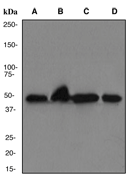
A. Western blot analysis on (A) HeLa (B) 293T (C) Jurkat (D) MCF7 cell lysates using anti-YBOX1 RabMAb (Cat. #AJ1823a), dilution 1:20,000.| Product Name | YBOX1 (YB-1) Antibody |
|---|---|
| Antibody Type | Primary Antibodies |
| Antigen Alias | uspD, Universal stress protein D |
| Clonality | Monoclonal |
|---|---|
| Clone Number | EP2706Y |
| Host Species | Rabbit |
| Tested Applications | WB |
| WB:1:10000~20000 |
|
| Species Reactivity | Human |
| Concentration | 1mg/ml |
| Gene Synonyms | NSEP1 YB1 |
|---|---|
| Alternative Names | uspD Universal stress protein D |
| Molecular Weight(MW) | 35924 Da |
| Function | Mediates pre-mRNA alternative splicing regulation. Binds to splice sites in pre-mRNA and regulates splice site selection Binds and stabilizes cytoplasmic mRNA. Contributes to the regulation of translation by modulating the interaction between the mRNA and eukaryotic initiation factors (By similarity) Regulates the transcription of numerous genes. Its transcriptional activity on the multidrug resistance gene MDR1 is enhanced in presence of the APEX1 acetylated form at 'Lys-6' and 'Lys-7' Binds to promoters that contain a Y-box (5'-CTGATTGGCCAA-3'), such as MDR1 and HLA class II genes. Promotes separation of DNA strands that contain mismatches or are modified by cisplatin. Has endonucleolytic activity and can introduce nicks or breaks into double-stranded DNA (in vitro). May play a role in DNA repair Component of the CRD-mediated complex that promotes MYC mRNA stability. Binds preferentially to the 5'-[CU]CUGCG-3' motif in vitro |
| Tissue Specificity | A synthetic peptide corresponding to residues near the N-terminus of human YBOX1 was used as an immunogen. |
| Cellular Localization | Cytoplasm. Nucleus. Cytoplasmic granule. Secreted. Note=Localized in cytoplasmic mRNP granules containing untranslated mRNAs. Shuttles between nucleus and cytoplasm Predominantly cytoplasmic in proliferating cells. Cytotoxic stress and DNA damage enhance translocation to the nucleus. Localized with DDX1, MBNL1 and TIAL1 in stress granules upon stress Secreted by mesangial and monocytic cells after inflammatory challenges. Translocates from the cytoplasm to the nucleus after and colocalizes with APEX1 in nuclear speckles after genotoxic stress |
| Entrez Gene | 4904 |
|---|
Application
A. Western blot analysis on (A) HeLa (B) 293T (C) Jurkat (D) MCF7 cell lysates using anti-YBOX1 RabMAb (Cat. #AJ1823a), dilution 1:20,000.| Application Notes | WB:1:10000~20000 |
|---|
| Form | Liquid |
|---|---|
| Storage Instructions | For short-term storage, store at 4° C. For long-term storage, aliquot and store at -20ºC or below. Avoid multiple freeze-thaw cycles. |
| Storage Buffer | 50 mM Tris-Glycine (pH 7.4), 0.15 M NaCl, 40% Glycerol, 0.01% sodium azide and 0.05% BSA. |


