Application
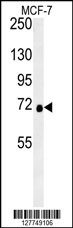
ZRAB3 Antibody (Center) western blot analysis in MCF-7 cell line lysates (35ug/lane).This demonstrates the ZRAB3 antibody detected the ZRAB3 protein (arrow).| Product Name | ZRAB3 Antibody (Center) |
|---|---|
| Antibody Type | Primary Antibodies |
| Antigen Alias | ZRANB3; Zinc finger Ran-binding domain-containing protein 3 |
| Clonality | Polyclonal |
|---|---|
| Isotype | Ig |
| Host Species | Rabbit |
| Tested Applications | WB |
| WB:1:100~500 |
|
| Species Reactivity | Human |
| Concentration | 1mg/ml |
| Alternative Names | ZRANB3 Zinc finger Ran-binding domain-containing protein 3 |
|---|---|
| Molecular Weight(MW) | 123248 Da |
| Function | DNA annealing helicase and endonuclease required to maintain genome stability at stalled or collapsed replication forks by facilitating fork restart and limiting inappropriate recombination that could occur during template switching events Recruited to the sites of stalled DNA replication by polyubiquitinated PCNA and acts as a structure-specific endonuclease that cleaves the replication fork D-loop intermediate, generating an accessible 3'-OH group in the template of the leading strand, which is amenable to extension by DNA polymerase. In addition to endonuclease activity, also catalyzes the fork regression via annealing helicase activity in order to prevent disintegration of the replication fork and the formation of double-strand breaks |
| Tissue Specificity | This ZRAB3 antibody is generated from rabbits immunized with a KLH conjugated synthetic peptide between 651-681 amino acids from the Central region of human ZRAB3. |
| Cellular Localization | Nucleus. Chromosome. Note=Following DNA damage, recruited to sites of DNA damage and stalled replication forks by polyubiquitinated PCNA |
| Entrez Gene | 84083 |
|---|---|
| Nucleotide Accession | NP_115519.2 |
Application
ZRAB3 Antibody (Center) western blot analysis in MCF-7 cell line lysates (35ug/lane).This demonstrates the ZRAB3 antibody detected the ZRAB3 protein (arrow).| Application Notes | WB:1:100~500 |
|---|
| Form | Liquid |
|---|---|
| Storage Instructions | For short-term storage, store at 4° C. For long-term storage, aliquot and store at -20ºC or below. Avoid multiple freeze-thaw cycles. |
| Storage Buffer | Purified polyclonal antibody supplied in PBS with 0.09% (W/V) sodium azide. This antibody is purified through a protein A column, followed by peptide affinity purification. |


