Application
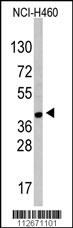
Western blot analysis of anti-TFAP2A Antibody (N-term) in NCI-H460 cell line lysates (35ug/lane). TFAP2A (arrow) was detected using the purified Pab (1:60 dilution).| Product Name | AP2 alpha Antibody (N-term) |
|---|---|
| Antibody Type | Primary Antibodies |
| Antigen Alias | TFAP2A; AP2TF; TFAP2; Transcription factor AP-2-alpha; AP-2 transcription factor; Activating enhancer-binding protein 2-alpha; Activator protein 2 |
| Clonality | Polyclonal |
|---|---|
| Isotype | Ig |
| Host Species | Rabbit |
| Tested Applications | WB |
| WB:1:50~100 |
|
| Species Reactivity | Human |
| Concentration | 1mg/ml |
| Gene Synonyms | AP2TF TFAP2 |
|---|---|
| Alternative Names | TFAP2A AP2TF TFAP2 Transcription factor AP-2-alpha AP-2 transcription factor Activating enhancer-binding protein 2-alpha Activator protein 2 |
| Molecular Weight(MW) | 48062 Da |
| Function | Sequence-specific DNA-binding protein that interacts with inducible viral and cellular enhancer elements to regulate transcription of selected genes. AP-2 factors bind to the consensus sequence 5'-GCCNNNGGC-3' and activate genes involved in a large spectrum of important biological functions including proper eye, face, body wall, limb and neural tube development They also suppress a number of genes including MCAM/MUC18, C/EBP alpha and MYC. AP-2-alpha is the only AP-2 protein required for early morphogenesis of the lens vesicle. Together with the CITED2 coactivator, stimulates the PITX2 P1 promoter transcription activation. Associates with chromatin to the PITX2 P1 promoter region |
| Tissue Specificity | This TFAP2A antibody is generated from rabbits immunized with a KLH conjugated synthetic peptide selected from the N-terminal region of human TFAP2A. |
| Cellular Localization | Nucleus. |
| Entrez Gene | 7020 |
|---|
Application
Western blot analysis of anti-TFAP2A Antibody (N-term) in NCI-H460 cell line lysates (35ug/lane). TFAP2A (arrow) was detected using the purified Pab (1:60 dilution).| Application Notes | WB:1:50~100 |
|---|
| Form | Liquid |
|---|---|
| Storage Instructions | For short-term storage, store at 4° C. For long-term storage, aliquot and store at -20ºC or below. Avoid multiple freeze-thaw cycles. |
| Storage Buffer | Purified polyclonal antibody supplied in PBS with 0.09% (W/V) sodium azide. This antibody is purified through a protein A column, eluted with high and low pH buffers and neutralized immediately, followed by dialysis against PBS. |


