Application
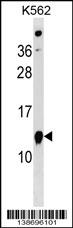
ATPIF1 Antibody (N-term) western blot analysis in K562 cell line lysates (35ug/lane).This demonstrates the ATPIF1 antibody detected the ATPIF1 protein (arrow).| Product Name | ATPIF1 Antibody (N-term) |
|---|---|
| Antibody Type | Primary Antibodies |
| Clonality | Polyclonal |
|---|---|
| Isotype | Ig |
| Host Species | Rabbit |
| Tested Applications | WB |
| WB:1:100~500 |
|
| Species Reactivity | Human |
| Concentration | 1mg/ml |
| Gene Synonyms | ATPI |
|---|---|
| Alternative Names | ATPIF1 ATPI ATPase inhibitor mitochondrial Inhibitor of F(1)F(o)-ATPase |
| Molecular Weight(MW) | 12249 Da |
| Function | Endogenous F(1)F(o)-ATPase inhibitor limiting ATP depletion when the mitochondrial membrane potential falls below a threshold and the F(1)F(o)-ATP synthase starts hydrolyzing ATP to pump protons out of the mitochondrial matrix. Required to avoid the consumption of cellular ATP when the F(1)F(o)-ATP synthase enzyme acts as an ATP hydrolase. Indirectly acts as a regulator of heme synthesis in erythroid tissues: regulates heme synthesis by modulating the mitochondrial pH and redox potential, allowing FECH to efficiently catalyze the incorporation of iron into protoporphyrin IX to produce heme |
| Tissue Specificity | This ATPIF1 antibody is generated from rabbits immunized with a KLH conjugated synthetic peptide between 8-35 amino acids from the N-terminal region of human ATPIF1. |
| Cellular Localization | Mitochondrion. |
| Entrez Gene | 93974 |
|---|---|
| Nucleotide Accession | NP_057395.1 |
Application
ATPIF1 Antibody (N-term) western blot analysis in K562 cell line lysates (35ug/lane).This demonstrates the ATPIF1 antibody detected the ATPIF1 protein (arrow).| Application Notes | WB:1:100~500 |
|---|
| Form | Liquid |
|---|---|
| Storage Instructions | For short-term storage, store at 4° C. For long-term storage, aliquot and store at -20ºC or below. Avoid multiple freeze-thaw cycles. |
| Storage Buffer | Purified polyclonal antibody supplied in PBS with 0.09% (W/V) sodium azide. This antibody is purified through a protein A column, followed by peptide affinity purification. |


