Application
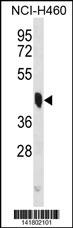
BAG1 Antibody (Center) western blot analysis in NCI-H460 cell line lysates (35ug/lane).This demonstrates the BAG1 antibody detected the BAG1 protein (arrow).| Product Name | BAG1 Antibody (Center) |
|---|---|
| Antibody Type | Primary Antibodies |
| Clonality | Polyclonal |
|---|---|
| Isotype | Ig |
| Host Species | Rabbit |
| Tested Applications | WB |
| WB:1:100~500 |
|
| Species Reactivity | Human |
| Concentration | 1mg/ml |
| Gene Synonyms | HAP |
|---|---|
| Alternative Names | BAG1 HAP BAG family molecular chaperone regulator 1 Bcl-2-associated athanogene 1 |
| Molecular Weight(MW) | 38779 Da |
| Function | Inhibits the chaperone activity of HSP70/HSC70 by promoting substrate release. Inhibits the pro-apoptotic function of PPP1R15A, and has anti-apoptotic activity. Markedly increases the anti-cell death function of BCL2 induced by various stimuli |
| Tissue Specificity | Isoform 4 is the most abundantly expressed isoform. It is ubiquitously expressed throughout most tissues, except the liver, colon, breast and uterine myometrium. Isoform 1 is expressed in the ovary and testis. Isoform 4 is expressed in several types of tumor cell lines, and at consistently high levels in leukemia and lymphoma cell lines. Isoform 1 is expressed in the prostate, breast and leukemia cell lines. Isoform 3 is the least abundant isoform in tumor cell lines (at protein level) |
| Cellular Localization | Isoform 1: Nucleus. Cytoplasm. Note=Isoform 1 localizes predominantly to the nucleus Isoform 4: Cytoplasm. Nucleus. Note=Isoform 4 localizes predominantly to the cytoplasm. The cellular background in which it is expressed can influence whether it resides primarily in the cytoplasm or is also found in the nucleus. In the presence of BCL2, localizes to intracellular membranes (what appears to be the nuclear envelope and perinuclear membranes) as well as punctate cytosolic structures suggestive of mitochondria |
| Entrez Gene | 573 |
|---|---|
| Nucleotide Accession | NP_004314.4 |
Application
BAG1 Antibody (Center) western blot analysis in NCI-H460 cell line lysates (35ug/lane).This demonstrates the BAG1 antibody detected the BAG1 protein (arrow).| Application Notes | WB:1:100~500 |
|---|
| Form | Liquid |
|---|---|
| Storage Instructions | For short-term storage, store at 4° C. For long-term storage, aliquot and store at -20ºC or below. Avoid multiple freeze-thaw cycles. |
| Storage Buffer | Purified polyclonal antibody supplied in PBS with 0.09% (W/V) sodium azide. This antibody is purified through a protein A column, followed by peptide affinity purification. |


