Application
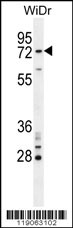
BARD1 Antibody (N-term) western blot analysis in WiDr cell line lysates (35ug/lane).This demonstrates the BARD1 antibody detected the BARD1 protein (arrow).| Product Name | BARD1 Antibody (N-term) |
|---|---|
| Antibody Type | Primary Antibodies |
| Clonality | Polyclonal |
|---|---|
| Isotype | Ig |
| Host Species | Rabbit |
| Tested Applications | WB |
| WB:1:100~500 |
|
| Species Reactivity | Human |
| Concentration | 1mg/ml |
| Alternative Names | BARD1 BRCA1-associated RING domain protein 1 |
|---|---|
| Molecular Weight(MW) | 86648 Da |
| Function | Probable E3 ubiquitin-protein ligase. The BRCA1-BARD1 heterodimer specifically mediates the formation of 'Lys-6'-linked polyubiquitin chains and coordinates a diverse range of cellular pathways such as DNA damage repair, ubiquitination and transcriptional regulation to maintain genomic stability. Plays a central role in the control of the cell cycle in response to DNA damage. Acts by mediating ubiquitin E3 ligase activity that is required for its tumor suppressor function. Also forms a heterodimer with CSTF1/CSTF-50 to modulate mRNA processing and RNAP II stability by inhibiting pre-mRNA 3' cleavage |
| Tissue Specificity | This BARD1 antibody is generated from rabbits immunized with a KLH conjugated synthetic peptide between 104-135 amino acids from the N-terminal region of human BARD1. |
| Cellular Localization | Nucleus. Note=During S phase of the cell cycle, colocalizes with BRCA1 into discrete subnuclear foci. Can translocate to the cytoplasm. Localizes at sites of DNA damage at double-strand breaks (DSBs); recruitment to DNA damage sites is mediated by the BRCA1-A complex |
Application
BARD1 Antibody (N-term) western blot analysis in WiDr cell line lysates (35ug/lane).This demonstrates the BARD1 antibody detected the BARD1 protein (arrow).| Application Notes | WB:1:100~500 |
|---|
| Form | Liquid |
|---|---|
| Storage Instructions | For short-term storage, store at 4° C. For long-term storage, aliquot and store at -20ºC or below. Avoid multiple freeze-thaw cycles. |
| Storage Buffer | Purified polyclonal antibody supplied in PBS with 0.09% (W/V) sodium azide. This antibody is purified through a protein A column, followed by peptide affinity purification. |


