Application
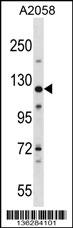
BAT3 Antibody (C-term) western blot analysis in A2058 cell line lysates (35ug/lane).This demonstrates the BAT3 antibody detected the BAT3 protein (arrow).| Product Name | BAT3 Antibody (C-term) |
|---|---|
| Antibody Type | Primary Antibodies |
| Clonality | Polyclonal |
|---|---|
| Isotype | Ig |
| Host Species | Rabbit |
| Tested Applications | WB |
| WB:1:100~500 |
|
| Species Reactivity | Human |
| Concentration | 1mg/ml |
| Gene Synonyms | BAT3, G3 |
|---|---|
| Alternative Names | BAG6 BAT3 G3 Large proline-rich protein BAG6 BAG family molecular chaperone regulator 6 BCL2-associated athanogene 6 HLA-B-associated transcript 3 Protein G3 Protein Scythe |
| Molecular Weight(MW) | 119409 Da |
| Function | Chaperone that plays a key role in various processes such as apoptosis, insertion of tail-anchored (TA) membrane proteins to the endoplasmic reticulum membrane and regulation of chromatin. Acts in part by regulating stability of proteins and their degradation by the proteasome. Participates in endoplasmic reticulum stress-induced apoptosis via its interaction with AIFM1/AIF by regulating AIFM1/AIF stability and preventing its degradation. Also required during spermatogenesis for synaptonemal complex assembly via its interaction with HSPA2, by inhibiting polyubiquitination and subsequent proteasomal degradation of HSPA2. Required for selective ubiquitin-mediated degradation of defective nascent chain polypeptides by the proteasome. In this context, may play a role in immuno-proteasomes to generate antigenic peptides via targeted degradation, thereby playing a role in antigen presentation in immune response. Key component of the BAG6/BAT3 complex, a cytosolic multiprotein complex involved in the post-translational delivery of tail-anchored (TA) membrane proteins to the endoplasmic reticulum membrane. TA membrane proteins, also named type II transmembrane proteins, contain a single C-terminal transmembrane region. BAG6/BAT3 acts by facilitating TA membrane proteins capture by ASNA1/TRC40: it is recruited to ribosomes synthesizing membrane proteins, interacts with the transmembrane region of newly released TA proteins and transfers them to ASNA1/TRC40 for targeting to the endoplasmic reticulum membrane Can be released from tumor and dendritic cells in membrane vesicles or exosomes, and engage NCR3 thereby promoting natural killer cell (NK) activation and cytotoxicity |
| Tissue Specificity | This BAT3 antibody is generated from rabbits immunized with a KLH conjugated synthetic peptide between 1071-1099 amino acids from the C-terminal region of human BAT3. |
| Cellular Localization | Cytoplasm, cytosol. Nucleus. Note=The C- terminal fragment generated by caspase-3 is cytoplasmic. Also found in extracellular vesicular exosomes in some tumor cells |
| Entrez Gene | 7917 |
|---|---|
| Nucleotide Accession | NP_001092004.1 NP_004630.3 |
Application
BAT3 Antibody (C-term) western blot analysis in A2058 cell line lysates (35ug/lane).This demonstrates the BAT3 antibody detected the BAT3 protein (arrow).| Application Notes | WB:1:100~500 |
|---|
| Form | Liquid |
|---|---|
| Storage Instructions | For short-term storage, store at 4° C. For long-term storage, aliquot and store at -20ºC or below. Avoid multiple freeze-thaw cycles. |
| Storage Buffer | Purified polyclonal antibody supplied in PBS with 0.09% (W/V) sodium azide. This antibody is purified through a protein A column, followed by peptide affinity purification. |


