Application
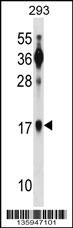
BATF Antibody (N-term) western blot analysis in 293 cell line lysates (35ug/lane).This demonstrates the BATF antibody detected the BATF protein (arrow).| Product Name | BATF Antibody (N-term) |
|---|---|
| Antibody Type | Primary Antibodies |
| Clonality | Polyclonal |
|---|---|
| Isotype | Ig |
| Host Species | Rabbit |
| Tested Applications | WB |
| WB:1:100~500 |
|
| Species Reactivity | Human |
| Concentration | 1mg/ml |
| Alternative Names | BATF Basic leucine zipper transcriptional factor ATF-like B-cell-activating transcription factor SF-HT-activated gene 2 protein |
|---|---|
| Molecular Weight(MW) | 14120 Da |
| Function | AP-1 family transcription factor that controls the differentiation of lineage-specific cells in the immune system: specifically mediates the differentiation of T-helper 17 cells (Th17), follicular T-helper cells (TfH), CD8(+) dendritic cells and class-switch recombination (CSR) in B-cells. Acts via the formation of a heterodimer with JUNB that recognizes and binds DNA sequence 5'-TGA[CG]TCA-3'. The BATF-JUNB heterodimer also forms a complex with IRF4 (or IRF8) in immune cells, leading to recognition of AICE sequence (5'-TGAnTCA/GAAA-3'), an immune- specific regulatory element, followed by cooperative binding of BATF and IRF4 (or IRF8) and activation of genes. Controls differentiation of T-helper cells producing interleukin-17 (Th17 cells) by binding to Th17-associated gene promoters: regulates expression of the transcription factor RORC itself and RORC target genes such as IL17 (IL17A or IL17B). Also involved in differentiation of follicular T-helper cells (TfH) by directing expression of BCL6 and MAF. In B-cells, involved in class-switch recombination (CSR) by controlling the expression of both AICDA and of germline transcripts of the intervening heavy-chain region and constant heavy-chain region (I(H)-C(H)). Following infection, can participate to CD8(+) dendritic cell differentiation via interaction with IRF4 and IRF8 to mediate cooperative gene activation. Regulates effector CD8(+) T-cell differentiation by regulating expression of SIRT1. Following DNA damage, part of a differentiation checkpoint that limits self-renewal of hematopoietic stem cells (HSCs): up-regulated by STAT3, leading to differentiation of HSCs, thereby restricting self-renewal of HSCs (By similarity) |
| Tissue Specificity | Expressed at highest levels in lung, and at lower levels in placenta, liver, kidney, spleen, and peripheral blood. Detected in SW480 colorectal cancer cell line and several hematopoietic tumor cell lines, including Raji Burkitt's lymphoma Strongly expressed in mature B- and T-lymphocytes. Also expressed in moderate levels in lymph node and appendix and at low levels in thymus and bone marrow (PubMed:10777209) |
| Cellular Localization | Nucleus (By similarity). Cytoplasm (By similarity). Note=Present in the nucleus and cytoplasm, but shows increased nuclear translocation after activation of T-cells (By similarity) |
| Entrez Gene | 10538 |
|---|---|
| Nucleotide Accession | NP_006390.1 |
Application
BATF Antibody (N-term) western blot analysis in 293 cell line lysates (35ug/lane).This demonstrates the BATF antibody detected the BATF protein (arrow).| Application Notes | WB:1:100~500 |
|---|
| Form | Liquid |
|---|---|
| Storage Instructions | For short-term storage, store at 4° C. For long-term storage, aliquot and store at -20ºC or below. Avoid multiple freeze-thaw cycles. |
| Storage Buffer | Purified polyclonal antibody supplied in PBS with 0.09% (W/V) sodium azide. This antibody is purified through a protein A column, followed by peptide affinity purification. |


