Application
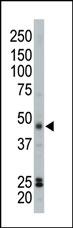
The anti-PRKACB Pab is used in Western blot to detect PRKACB in A375 cell lysate.| Product Name | c-AMPProtein Kinase Catalytic subnunit Antibody (N-term E32) |
|---|---|
| Antibody Type | Primary Antibodies |
| Antigen Alias | PRKACB; cAMP-dependent protein kinase catalytic subunit beta |
| Clonality | Polyclonal |
|---|---|
| Isotype | Ig |
| Host Species | Rabbit |
| Tested Applications | WB |
| WB:1:100~500 |
|
| Species Reactivity | Human |
| Concentration | 1mg/ml |
| Alternative Names | PRKACB cAMP-dependent protein kinase catalytic subunit beta |
|---|---|
| Molecular Weight(MW) | 40623 Da |
| Function | Mediates cAMP-dependent signaling triggered by receptor binding to GPCRs. PKA activation regulates diverse cellular processes such as cell proliferation, the cell cycle, differentiation and regulation of microtubule dynamics, chromatin condensation and decondensation, nuclear envelope disassembly and reassembly, as well as regulation of intracellular transport mechanisms and ion flux. Regulates the abundance of compartmentalized pools of its regulatory subunits through phosphorylation of PJA2 which binds and ubiquitinates these subunits, leading to their subsequent proteolysis |
| Tissue Specificity | Isoform 1 is most abundant in the brain, with low level expression in kidney. Isoform 2 is predominantly expressed in thymus, spleen and kidney. Isoform 3 and isoform 4 are only expressed in the brain |
| Cellular Localization | Cytoplasm. Cell membrane. Nucleus (By similarity). Note=Translocates into the nucleus (monomeric catalytic subunit) (By similarity). The inactive holoenzyme is found in the cytoplasm (By similarity) |
| Entrez Gene | 5567 |
|---|
Application
The anti-PRKACB Pab is used in Western blot to detect PRKACB in A375 cell lysate.| Application Notes | WB:1:100~500 |
|---|
| Form | Liquid |
|---|---|
| Storage Instructions | For short-term storage, store at 4° C. For long-term storage, aliquot and store at -20ºC or below. Avoid multiple freeze-thaw cycles. |
| Storage Buffer | Purified polyclonal antibody supplied in PBS with 0.09% (W/V) sodium azide. This antibody is purified through a protein G column, eluted with high and low pH buffers and neutralized immediately, followed by dialysis against PBS. |


