Application
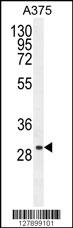
C6orf154 Antibody (N-term) western blot analysis in A375 cell line lysates (35ug/lane).This demonstrates the C6orf154 antibody detected the C6orf154 protein (arrow).Application
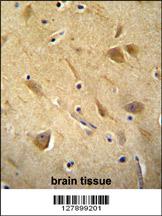
C6orf154 antibody (N-term) immunohistochemistry analysis in formalin fixed and paraffin embedded human brain tissue followed by peroxidase conjugation of the secondary antibody and DAB staining.This data demonstrates the use of the C6orf154 antibody (N-term) for immunohistochemistry. Clinical relevance has not been evaluated.Application
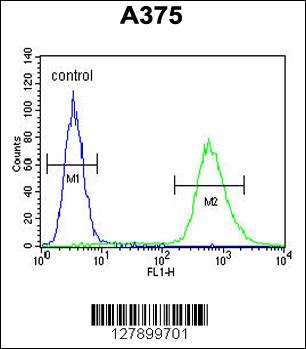
C6orf154 Antibody (N-term) flow cytometric analysis of A375 cells (right histogram) compared to a negative control cell (left histogram).FITC-conjugated goat-anti-rabbit secondary antibodies were used for the analysis.| Product Name | C6orf154 Antibody (N-term) |
|---|---|
| Antibody Type | Primary Antibodies |
| Antigen Alias | LRRC73; C6orf154; Leucine-rich repeat-containing protein 73 |
| Clonality | Polyclonal |
|---|---|
| Isotype | Ig |
| Host Species | Rabbit |
| Tested Applications | WBIHCFC |
| WB:1:100~500 IHC |
|
| Species Reactivity | Human |
| Concentration | 1mg/ml |
| Gene Synonyms | C6orf154 |
|---|---|
| Alternative Names | LRRC73 C6orf154 Leucine-rich repeat-containing protein 73 |
| Molecular Weight(MW) | 33409 Da |
| Tissue Specificity | This C6orf154 antibody is generated from rabbits immunized with a KLH conjugated synthetic peptide between 1-30 amino acids from the N-terminal region of human C6orf154. |
| Entrez Gene | 221424 |
|---|---|
| Nucleotide Accession | NP_001012992.1 |
Application
C6orf154 Antibody (N-term) western blot analysis in A375 cell line lysates (35ug/lane).This demonstrates the C6orf154 antibody detected the C6orf154 protein (arrow).
Application
C6orf154 antibody (N-term) immunohistochemistry analysis in formalin fixed and paraffin embedded human brain tissue followed by peroxidase conjugation of the secondary antibody and DAB staining.This data demonstrates the use of the C6orf154 antibody (N-term) for immunohistochemistry. Clinical relevance has not been evaluated.
Application
C6orf154 Antibody (N-term) flow cytometric analysis of A375 cells (right histogram) compared to a negative control cell (left histogram).FITC-conjugated goat-anti-rabbit secondary antibodies were used for the analysis.| Application Notes | WB:1:100~500 IHC |
|---|
| Form | Liquid |
|---|---|
| Storage Instructions | For short-term storage, store at 4° C. For long-term storage, aliquot and store at -20ºC or below. Avoid multiple freeze-thaw cycles. |
| Storage Buffer | Purified polyclonal antibody supplied in PBS with 0.09% (W/V) sodium azide. This antibody is purified through a protein A column, followed by peptide affinity purification. |


