Application
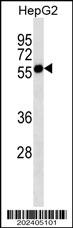
CASP2 Antibody(Ascites)(Cat. #AM2113a) western blot analysis in HepG2 cell line lysates (35ug/lane).This demonstrates the CASP2 antibody detected the CASP2 protein (arrow).| Product Name | CASP2 Antibody (Ascites) |
|---|---|
| Antibody Type | Primary Antibodies |
| Antigen Alias | CASP8; MCH5; Caspase-8; Apoptotic cysteine protease; Apoptotic protease Mch-5; CAP4; FADD-homologous ICE/ced-3-like protease; FADD-like ICE; ICE-like apoptotic protease 5; MORT1-associated ced-3 homolog; Caspase-8 subunit p18; Caspase-8 subunit p10 |
| Clonality | Monoclonal |
|---|---|
| Isotype | IgG1 |
| Clone Number | 550CT8.5.2 |
| Host Species | Mouse |
| Tested Applications | WB |
| WB:1:1000~16000 |
|
| Species Reactivity | Human |
| Concentration | 1mg/ml |
| Gene Synonyms | MCH5 |
|---|---|
| Alternative Names | CASP8 MCH5 Caspase-8 Apoptotic cysteine protease Apoptotic protease Mch-5 CAP4 FADD-homologous ICE/ced-3-like protease FADD-like ICE ICE-like apoptotic protease 5 MORT1-associated ced-3 homolog Caspase-8 subunit p18 Caspase-8 subunit p10 |
| Molecular Weight(MW) | 55391 Da |
| Function | Most upstream protease of the activation cascade of caspases responsible for the TNFRSF6/FAS mediated and TNFRSF1A induced cell death. Binding to the adapter molecule FADD recruits it to either receptor. The resulting aggregate called death- inducing signaling complex (DISC) performs CASP8 proteolytic activation. The active dimeric enzyme is then liberated from the DISC and free to activate downstream apoptotic proteases Proteolytic fragments of the N-terminal propeptide (termed CAP3, CAP5 and CAP6) are likely retained in the DISC. Cleaves and activates CASP3, CASP4, CASP6, CASP7, CASP9 and CASP10. May participate in the GZMB apoptotic pathways. Cleaves ADPRT Hydrolyzes the small-molecule substrate, Ac-Asp-Glu-Val-Asp-|-AMC Likely target for the cowpox virus CRMA death inhibitory protein Isoform 5, isoform 6, isoform 7 and isoform 8 lack the catalytic site and may interfere with the pro-apoptotic activity of the complex |
| Tissue Specificity | Isoform 1, isoform 5 and isoform 7 are expressed in a wide variety of tissues. Highest expression in peripheral blood leukocytes, spleen, thymus and liver. Barely detectable in brain, testis and skeletal muscle |
| Cellular Localization | Cytoplasm. |
Application
CASP2 Antibody(Ascites)(Cat. #AM2113a) western blot analysis in HepG2 cell line lysates (35ug/lane).This demonstrates the CASP2 antibody detected the CASP2 protein (arrow).| Application Notes | WB:1:1000~16000 |
|---|
| Form | Liquid |
|---|---|
| Storage Instructions | For short-term storage, store at 4° C. For long-term storage, aliquot and store at -20ºC or below. Avoid multiple freeze-thaw cycles. |
| Storage Buffer | Mouse monoclonal antibody supplied in crude ascites with 0.09% (W/V) sodium azide. |


