Application
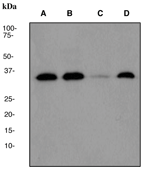
A. Western blot analysis on (A) HeLa (B) MCF-7 (C) Romas and (D) K562 cell lysates using anti-CDK4 RabMAb (Cat. #AJ1178a), dilution 1:500.| Product Name | Cdk4 Antibody |
|---|---|
| Antibody Type | Primary Antibodies |
| Antigen Alias | Cyclin-dependent kinase 4, isoform CRA_a |
| Clonality | Monoclonal |
|---|---|
| Clone Number | EPR2513Y |
| Host Species | Rabbit |
| Tested Applications | WB |
| WB:1:500 |
|
| Species Reactivity | Human |
| Concentration | 1mg/ml |
| Alternative Names | Cyclin-dependent kinase 4 isoform CRA_a |
|---|---|
| Molecular Weight(MW) | 33730 Da |
| Function | Ser/Thr-kinase component of cyclin D-CDK4 (DC) complexes that phosphorylate and inhibit members of the retinoblastoma (RB) protein family including RB1 and regulate the cell-cycle during G(1)/S transition. Phosphorylation of RB1 allows dissociation of the transcription factor E2F from the RB/E2F complexes and the subsequent transcription of E2F target genes which are responsible for the progression through the G(1) phase. Hypophosphorylates RB1 in early G(1) phase. Cyclin D-CDK4 complexes are major integrators of various mitogenenic and antimitogenic signals. Also phosphorylates SMAD3 in a cell-cycle-dependent manner and represses its transcriptional activity. Component of the ternary complex, cyclin D/CDK4/CDKN1B, required for nuclear translocation and activity of the cyclin D-CDK4 complex |
| Tissue Specificity | A synthetic peptide corresponding to residues on the N-terminus of human CDK4 was used as an immunogen. |
| Cellular Localization | Cytoplasm. Nucleus. Membrane. Note=Cytoplasmic when non-complexed. Forms a cyclin D-CDK4 complex in the cytoplasm as cells progress through G(1) phase. The complex accumulates on the nuclear membrane and enters the nucleus on transition from G(1) to S phase. Also present in nucleoli and heterochromatin lumps. Colocalizes with RB1 after release into the nucleus |
| Entrez Gene | 1019 |
|---|
Application
A. Western blot analysis on (A) HeLa (B) MCF-7 (C) Romas and (D) K562 cell lysates using anti-CDK4 RabMAb (Cat. #AJ1178a), dilution 1:500.| Application Notes | WB:1:500 |
|---|
| Form | Liquid |
|---|---|
| Storage Instructions | For short-term storage, store at 4° C. For long-term storage, aliquot and store at -20ºC or below. Avoid multiple freeze-thaw cycles. |
| Storage Buffer | 50 mM Tris-Glycine (pH 7.4), 0.15 M NaCl, 40% Glycerol, 0.01% sodium azide and 0.05% BSA. |


