Application
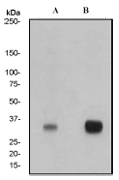
A. Western blot analysis on HeLa cell lysates using anti-Phospho-Cdk2 (pT14) RabMAb (Cat. #AJ1177b), 1:20,000 dilution. Cells were either (A) untreated (B) treated with hydroxyurea.Application
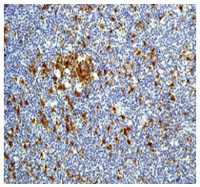
B. Immunohistochemical analysis of paraffin-embedded human tonsils using anti-Phospho-Cdk2 (pT14) (Cat. #AJ1177b).| Product Name | Cdk2 Antibody Phospho (pT14) |
|---|---|
| Antibody Type | Primary Antibodies |
| Antigen Alias | CDK2, Cell division protein kinase 2, p33 protein kinase |
| Modification | p-T14 |
| Clonality | Monoclonal |
|---|---|
| Clone Number | EP2234Y |
| Host Species | Rabbit |
| Tested Applications | WBIHC |
| WB:1:1000~10000 IHC |
|
| Species Reactivity | Human |
| Concentration | 1mg/ml |
| Gene Synonyms | CDKN2 |
|---|---|
| Alternative Names | CDK2 Cell division protein kinase 2 p33 protein kinase |
| Molecular Weight(MW) | 33930 Da |
| Function | Serine/threonine-protein kinase involved in the control of the cell cycle; essential for meiosis, but dispensable for mitosis. Phosphorylates CTNNB1, USP37, p53/TP53, NPM1, CDK7, RB1, BRCA2, MYC, NPAT, EZH2. Interacts with cyclins A, B1, B3, D, or E Triggers duplication of centrosomes and DNA. Acts at the G1-S transition to promote the E2F transcriptional program and the initiation of DNA synthesis, and modulates G2 progression; controls the timing of entry into mitosis/meiosis by controlling the subsequent activation of cyclin B/CDK1 by phosphorylation, and coordinates the activation of cyclin B/CDK1 at the centrosome and in the nucleus. Crucial role in orchestrating a fine balance between cellular proliferation, cell death, and DNA repair in human embryonic stem cells (hESCs). Activity of CDK2 is maximal during S phase and G2; activated by interaction with cyclin E during the early stages of DNA synthesis to permit G1-S transition, and subsequently activated by cyclin A2 (cyclin A1 in germ cells) during the late stages of DNA replication to drive the transition from S phase to mitosis, the G2 phase. EZH2 phosphorylation promotes H3K27me3 maintenance and epigenetic gene silencing. Phosphorylates CABLES1 (By similarity). Cyclin E/CDK2 prevents oxidative stress-mediated Ras-induced senescence by phosphorylating MYC. Involved in G1-S phase DNA damage checkpoint that prevents cells with damaged DNA from initiating mitosis; regulates homologous recombination-dependent repair by phosphorylating BRCA2, this phosphorylation is low in S phase when recombination is active, but increases as cells progress towards mitosis. In response to DNA damage, double-strand break repair by homologous recombination a reduction of CDK2-mediated BRCA2 phosphorylation. Phosphorylation of RB1 disturbs its interaction with E2F1. NPM1 phosphorylation by cyclin E/CDK2 promotes its dissociates from unduplicated centrosomes, thus initiating centrosome duplication. Cyclin E/CDK2-mediated phosphorylation of NPAT at G1-S transition and until prophase stimulates the NPAT- mediated activation of histone gene transcription during S phase Required for vitamin D-mediated growth inhibition by being itself inactivated. Involved in the nitric oxide- (NO) mediated signaling in a nitrosylation/activation-dependent manner. USP37 is activated by phosphorylation and thus triggers G1-S transition. CTNNB1 phosphorylation regulates insulin internalization |
| Tissue Specificity | A synthetic phospho-peptide corresponding to residues surrounding Thr14 of human Cdk2 was used as immunogen. The antibody detects Cdk2 phosphorylated on Threonine 14. |
| Cellular Localization | Cytoplasm, cytoskeleton, centrosome. Nucleus, Cajal body. Cytoplasm. Endosome. Note=Localized at the centrosomes in late G2 phase after separation of the centrosomes but before the start of prophase. Nuclear-cytoplasmic trafficking is mediated during the inhibition by 1,25-(OH)(2)D(3) |
| Entrez Gene | 1017 |
|---|
Application
A. Western blot analysis on HeLa cell lysates using anti-Phospho-Cdk2 (pT14) RabMAb (Cat. #AJ1177b), 1:20,000 dilution. Cells were either (A) untreated (B) treated with hydroxyurea.
Application
B. Immunohistochemical analysis of paraffin-embedded human tonsils using anti-Phospho-Cdk2 (pT14) (Cat. #AJ1177b).| Application Notes | WB:1:1000~10000 IHC |
|---|
| Form | Liquid |
|---|---|
| Storage Instructions | For short-term storage, store at 4° C. For long-term storage, aliquot and store at -20ºC or below. Avoid multiple freeze-thaw cycles. |
| Storage Buffer | 50 mM Tris-Glycine (pH 7.4), 0.15 M NaCl, 40% Glycerol, 0.01% sodium azide and 0.05% BSA. |


