Application
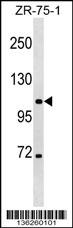
CLCN3 Antibody (Center) western blot analysis in ZR-75-1 cell line lysates (35ug/lane).This demonstrates the CLCN3 antibody detected the CLCN3 protein (arrow).| Product Name | CLCN3 Antibody (Center) |
|---|---|
| Antibody Type | Primary Antibodies |
| Antigen Alias | CLCN3; H(+)/Cl(-) exchange transporter 3; Chloride channel protein 3; Chloride transporter ClC-3 |
| Clonality | Polyclonal |
|---|---|
| Isotype | Ig |
| Host Species | Rabbit |
| Tested Applications | WB |
| WB:1:100~500 |
|
| Species Reactivity | Human |
| Concentration | 1mg/ml |
| Alternative Names | CLCN3 H(+)/Cl(-) exchange transporter 3 Chloride channel protein 3 Chloride transporter ClC-3 |
|---|---|
| Molecular Weight(MW) | 90966 Da |
| Function | Mediates the exchange of chloride ions against protons. Functions as antiporter and contributes to the acidification of the endosome and synaptic vesicle lumen, and may thereby affect vesicle trafficking and exocytosis. May play an important role in neuronal cell function through regulation of membrane excitability by protein kinase C. It could help neuronal cells to establish short-term memory |
| Tissue Specificity | Expressed primarily in tissues derived from neuroectoderm. Within the brain, its expression is particularly evident in the hippocampus, olfactory cortex, and olfactory bulb Highly expressed in aortic and coronary vascular smooth muscle cells, and aortic endothelial cells. Also expressed in tracheal and alveolar epithelial cells, and intima and media of the pulmonary vessels. Expressed in bronchus and colon (at protein level) |
| Cellular Localization | Isoform 1: Membrane; Multi-pass membrane protein. Early endosome membrane; Multi-pass membrane protein Late endosome membrane; Multi-pass membrane protein. Cytoplasmic vesicle, secretory vesicle membrane; Multi-pass membrane protein (By similarity). Note=Isoform 1 is localized mainly in early and late endosomes |
| Entrez Gene | 1182 |
|---|---|
| Nucleotide Accession | NP_776297.2 NP_001820.2 |
Application
CLCN3 Antibody (Center) western blot analysis in ZR-75-1 cell line lysates (35ug/lane).This demonstrates the CLCN3 antibody detected the CLCN3 protein (arrow).| Application Notes | WB:1:100~500 |
|---|
| Form | Liquid |
|---|---|
| Storage Instructions | For short-term storage, store at 4° C. For long-term storage, aliquot and store at -20ºC or below. Avoid multiple freeze-thaw cycles. |
| Storage Buffer | Purified polyclonal antibody supplied in PBS with 0.09% (W/V) sodium azide. This antibody is purified through a protein A column, followed by peptide affinity purification. |


