Application
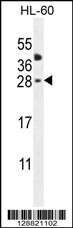
CLEC2A Antibody (Center) western blot analysis in HL-60 cell line lysates (35ug/lane).This demonstrates the CLEC2A antibody detected the CLEC2A protein (arrow).| Product Name | CLEC2A Antibody (Center) |
|---|---|
| Antibody Type | Primary Antibodies |
| Antigen Alias | CLEC2A; KACL; C-type lectin domain family 2 member A; Keratinocyte-associated C-type lectin; Proliferation-induced lymphocyte-associated receptor |
| Clonality | Polyclonal |
|---|---|
| Isotype | Ig |
| Host Species | Rabbit |
| Tested Applications | WB |
| WB:1:100~500 |
|
| Species Reactivity | Human |
| Concentration | 1mg/ml |
| Gene Synonyms | KACL |
|---|---|
| Alternative Names | CLEC2A KACL C-type lectin domain family 2 member A Keratinocyte-associated C-type lectin Proliferation-induced lymphocyte-associated receptor |
| Molecular Weight(MW) | 19972 Da |
| Function | Plays a role in modulating the extent of T-cell expansion. Enhances the expansion of TCR-stimulated T-cells by increasing their survival through enhanced expression of anti- apoptotic proteins. May modulate the capacity of T-cells to home to lymph nodes through SELL. Facilitates dedicated immune recognition of keratinocytes via interaction with its receptor KLRF2 by stimulating natural killer cell mediated cytotoxicity |
| Tissue Specificity | Mainly expressed in skin. Also expressed in keratinocytes, spleen, thymus, small intestine, peripheral blood monocytes, bone marrow, ovary, testis and skin. High expression in CD8(+), B-lymphocytes and naive CD4(+) T-cells. Restricted mostly to proliferating lymphocytes. Not detected in myeloid leukocytes or natural killer (NK) cells |
| Cellular Localization | Cell membrane; Single-pass type II membrane protein |
| Entrez Gene | 387836 |
|---|---|
| Nucleotide Accession | NP_001124183.1 |
Application
CLEC2A Antibody (Center) western blot analysis in HL-60 cell line lysates (35ug/lane).This demonstrates the CLEC2A antibody detected the CLEC2A protein (arrow).| Application Notes | WB:1:100~500 |
|---|
| Form | Liquid |
|---|---|
| Storage Instructions | For short-term storage, store at 4° C. For long-term storage, aliquot and store at -20ºC or below. Avoid multiple freeze-thaw cycles. |
| Storage Buffer | Purified polyclonal antibody supplied in PBS with 0.09% (W/V) sodium azide. This antibody is purified through a protein A column, followed by peptide affinity purification. |


