Application
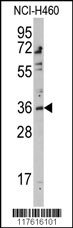
Western blot analysis of anti-COPS6 Antibody (Center) in NCI-H460 cell line lysates (35ug/lane). COPS6(arrow) was detected using the purified Pab.| Product Name | COPS6 Antibody (Center) |
|---|---|
| Antibody Type | Primary Antibodies |
| Antigen Alias | COPS6; CSN6; HVIP; COP9 signalosome complex subunit 6; JAB1-containing signalosome subunit 6; MOV34 homolog; Vpr-interacting protein |
| Clonality | Polyclonal |
|---|---|
| Isotype | Ig |
| Host Species | Rabbit |
| Tested Applications | WB |
| WB:1:50~100 |
|
| Species Reactivity | Human |
| Concentration | 1mg/ml |
| Gene Synonyms | CSN6 HVIP |
|---|---|
| Alternative Names | COPS6 CSN6 HVIP COP9 signalosome complex subunit 6 JAB1-containing signalosome subunit 6 MOV34 homolog Vpr-interacting protein |
| Molecular Weight(MW) | 36163 Da |
| Function | Component of the COP9 signalosome complex (CSN), a complex involved in various cellular and developmental processes The CSN complex is an essential regulator of the ubiquitin (Ubl) conjugation pathway by mediating the deneddylation of the cullin subunits of SCF-type E3 ligase complexes, leading to decrease the Ubl ligase activity of SCF-type complexes such as SCF, CSA or DDB2. The complex is also involved in phosphorylation of p53/TP53, c-jun/JUN, IkappaBalpha/NFKBIA, ITPK1 and IRF8, possibly via its association with CK2 and PKD kinases. CSN-dependent phosphorylation of TP53 and JUN promotes and protects degradation by the Ubl system, respectively. Has some glucocorticoid receptor- responsive activity. Stabilizes RFWD2/COP1 through reducing RFWD2 auto-ubiquitination and decelerating RFWD2 turnover rate, hence regulates the ubiquitination of RFWD2 targets |
| Tissue Specificity | Widely expressed. |
| Cellular Localization | Nucleus. Cytoplasm. Note=The interaction with HIV-1 Vpr protein possibly leads its translocation to a perinuclear region |
| Entrez Gene | 10980 |
|---|
Application
Western blot analysis of anti-COPS6 Antibody (Center) in NCI-H460 cell line lysates (35ug/lane). COPS6(arrow) was detected using the purified Pab.| Application Notes | WB:1:50~100 |
|---|
| Form | Liquid |
|---|---|
| Storage Instructions | For short-term storage, store at 4° C. For long-term storage, aliquot and store at -20ºC or below. Avoid multiple freeze-thaw cycles. |
| Storage Buffer | Purified polyclonal antibody supplied in PBS with 0.09% (W/V) sodium azide. This antibody is prepared by Saturated Ammonium Sulfate (SAS) precipitation followed by dialysis against PBS. |


