Application
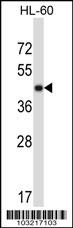
CSK Antibody (Q435) western blot analysis in HL-60 cell line lysates (35ug/lane).This demonstrates the CSK antibody detected the CSK protein (arrow).| Product Name | CSK Antibody (C-term) |
|---|---|
| Antibody Type | Primary Antibodies |
| Antigen Alias | CSK; Tyrosine-protein kinase CSK; C-Src kinase; Protein-tyrosine kinase CYL |
| Clonality | Polyclonal |
|---|---|
| Isotype | Ig |
| Host Species | Rabbit |
| Tested Applications | WB |
| WB:1:100~500 |
|
| Species Reactivity | Human |
| Concentration | 1mg/ml |
| Alternative Names | CSK Tyrosine-protein kinase CSK C-Src kinase Protein-tyrosine kinase CYL |
|---|---|
| Molecular Weight(MW) | 50704 Da |
| Function | Non-receptor tyrosine-protein kinase that plays an important role in the regulation of cell growth, differentiation, migration and immune response. Phosphorylates tyrosine residues located in the C-terminal tails of Src-family kinases (SFKs) including LCK, SRC, HCK, FYN, LYN or YES1. Upon tail phosphorylation, Src-family members engage in intramolecular interactions between the phosphotyrosine tail and the SH2 domain that result in an inactive conformation. To inhibit SFKs, CSK is recruited to the plasma membrane via binding to transmembrane proteins or adapter proteins located near the plasma membrane Suppresses signaling by various surface receptors, including T- cell receptor (TCR) and B-cell receptor (BCR) by phosphorylating and maintaining inactive several positive effectors such as FYN or LCK |
| Tissue Specificity | Expressed in lung and macrophages. |
| Cellular Localization | Cytoplasm (By similarity). Cell membrane (By similarity). Note=Mainly cytoplasmic, also present in lipid rafts (By similarity) |
| Entrez Gene | 1445 |
|---|
Application
CSK Antibody (Q435) western blot analysis in HL-60 cell line lysates (35ug/lane).This demonstrates the CSK antibody detected the CSK protein (arrow).| Application Notes | WB:1:100~500 |
|---|
| Form | Liquid |
|---|---|
| Storage Instructions | For short-term storage, store at 4° C. For long-term storage, aliquot and store at -20ºC or below. Avoid multiple freeze-thaw cycles. |
| Storage Buffer | Purified polyclonal antibody supplied in PBS with 0.09% (W/V) sodium azide. This antibody is purified through a protein G column, eluted with high and low pH buffers and neutralized immediately, followed by dialysis against PBS. |


