Application
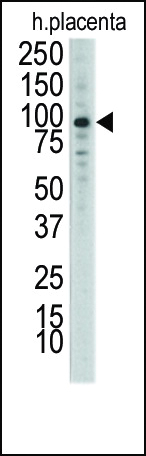
Western blot analysis of anti-DDR1 Antibody (N-term) Pab in placenta lysate. DDR1 (arrow) was detected using purified Pab. Secondary HRP-anti-rabbit was used for signal visualization with chemiluminescence.Application
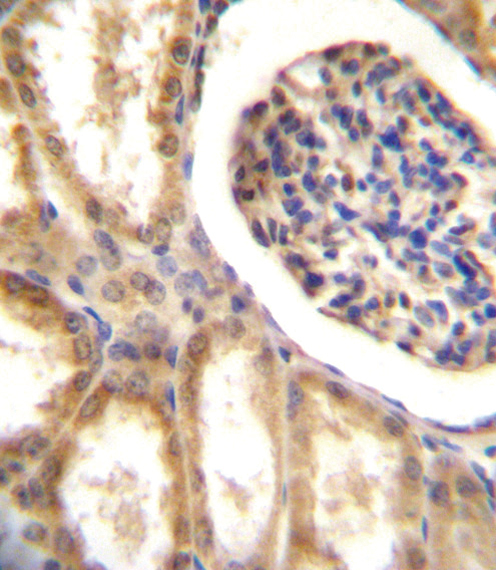
DDR1 Antibody (N-term) immunohistochemistry analysis in formalin fixed and paraffin embedded human kidney tissue followed by peroxidase conjugation of the secondary antibody and DAB staining.This data demonstrates the use of DDR1 Antibody (N-term) for immunohistochemistry. Clinical relevance has not been evaluated.Application
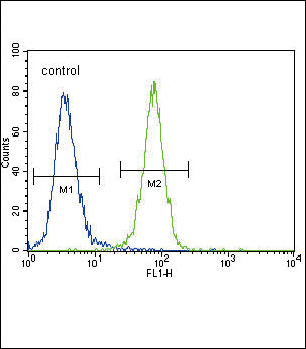
DDR1 Antibody (N-term) flow cytometric analysis of 293 cells (right histogram) compared to a negative control cell (left histogram).FITC-conjugated goat-anti-rabbit secondary antibodies were used for the analysis.| Product Name | DDR1 Antibody (N-term) |
|---|---|
| Antibody Type | Primary Antibodies |
| Antigen Alias | DDR1; CAK; EDDR1; NEP; NTRK4; PTK3A; RTK6; TRKE; Epithelial discoidin domain-containing receptor 1; CD167 antigen-like family member A; Cell adhesion kinase; Discoidin receptor tyrosine kinase; HGK2; Mammary carcinoma kinase 10; Protein-tyrosine kinase 3A; |
| Clonality | Polyclonal |
|---|---|
| Isotype | Ig |
| Host Species | Rabbit |
| Tested Applications | WBIHCFC |
| WB:1:100~500 IHC |
|
| Species Reactivity | Human |
| Concentration | 1mg/ml |
| Gene Synonyms | CAK EDDR1 NEP NTRK4 PTK3A RTK6 TRK |
|---|---|
| Alternative Names | DDR1 CAK EDDR1 NEP NTRK4 PTK3A RTK6 TRKE Epithelial discoidin domain-containing receptor 1 CD167 antigen-like family member A Cell adhesion kinase Discoidin receptor tyrosine kinase HGK2 Mammary carcinoma kinase 10 Protein-tyrosine kinase 3A |
| Molecular Weight(MW) | 101128 Da |
| Function | Tyrosine kinase that functions as cell surface receptor for fibrillar collagen and regulates cell attachment to the extracellular matrix, remodeling of the extracellular matrix, cell migration, differentiation, survival and cell proliferation Collagen binding triggers a signaling pathway that involves SRC and leads to the activation of MAP kinases. Regulates remodeling of the extracellular matrix by up-regulation of the matrix metalloproteinases MMP2, MMP7 and MMP9, and thereby facilitates cell migration and wound healing. Required for normal blastocyst implantation during pregnancy, for normal mammary gland differentiation and normal lactation. Required for normal ear morphology and normal hearing (By similarity). Promotes smooth muscle cell migration, and thereby contributes to arterial wound healing. Also plays a role in tumor cell invasion. Phosphorylates PTPN11 |
| Tissue Specificity | Detected in T-47D, MDA-MB-175 and HBL-100 breast carcinoma cells, A-431 epidermoid carcinoma cells, SW48 and SNU-C2B colon carcinoma cells and Hs 294T melanoma cells (at protein level). Expressed at low levels in most adult tissues and is highest in the brain, lung, placenta and kidney. Lower levels of expression are detected in melanocytes, heart, liver, skeletal muscle and pancreas. Abundant in breast carcinoma cell lines. In the colonic mucosa, expressed in epithelia but not in the connective tissue of the lamina propria. In the thyroid gland, expressed in the epithelium of the thyroid follicles. In pancreas, expressed in the islets of Langerhans cells, but not in the surrounding epithelial cells of the exocrine pancreas. In kidney, expressed in the epithelia of the distal tubules. Not expressed in connective tissue, endothelial cells, adipose tissue, muscle cells or cells of hematopoietic origin |
| Cellular Localization | Isoform 1: Cell membrane; Single-pass type I membrane protein Isoform 3: Secreted (Potential). |
| Entrez Gene | 780 |
|---|
Application
Western blot analysis of anti-DDR1 Antibody (N-term) Pab in placenta lysate. DDR1 (arrow) was detected using purified Pab. Secondary HRP-anti-rabbit was used for signal visualization with chemiluminescence.
Application
DDR1 Antibody (N-term) immunohistochemistry analysis in formalin fixed and paraffin embedded human kidney tissue followed by peroxidase conjugation of the secondary antibody and DAB staining.This data demonstrates the use of DDR1 Antibody (N-term) for immunohistochemistry. Clinical relevance has not been evaluated.
Application
DDR1 Antibody (N-term) flow cytometric analysis of 293 cells (right histogram) compared to a negative control cell (left histogram).FITC-conjugated goat-anti-rabbit secondary antibodies were used for the analysis.| Application Notes | WB:1:100~500 IHC |
|---|
| Form | Liquid |
|---|---|
| Storage Instructions | For short-term storage, store at 4° C. For long-term storage, aliquot and store at -20ºC or below. Avoid multiple freeze-thaw cycles. |
| Storage Buffer | Purified polyclonal antibody supplied in PBS with 0.09% (W/V) sodium azide. This antibody is purified through a protein G column, eluted with high and low pH buffers and neutralized immediately, followed by dialysis against PBS. |


