Application
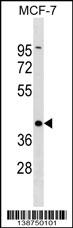
DMRT1 Antibody (C-term) western blot analysis in MCF-7 cell line lysates (35ug/lane).This demonstrates the DMRT1 antibody detected the DMRT1 protein (arrow).| Product Name | DMRT1 Antibody (C-term) |
|---|---|
| Antibody Type | Primary Antibodies |
| Antigen Alias | DMRT1; DMT1; Doublesex- and mab-3-related transcription factor 1; DM domain expressed in testis protein 1 |
| Clonality | Polyclonal |
|---|---|
| Isotype | Ig |
| Host Species | Rabbit |
| Tested Applications | WB |
| WB:1:100~500 |
|
| Species Reactivity | Human |
| Concentration | 1mg/ml |
| Gene Synonyms | DMT1 |
|---|---|
| Alternative Names | DMRT1 DMT1 Doublesex- and mab-3-related transcription factor 1 DM domain expressed in testis protein 1 |
| Molecular Weight(MW) | 39473 Da |
| Function | Transcription factor that plays a key role in male sex determination and differentiation by controlling testis development and male germ cell proliferation. Plays a central role in spermatogonia by inhibiting meiosis in undifferentiated spermatogonia and promoting mitosis, leading to spermatogonial development and allowing abundant and continuous production of sperm. Acts both as a transcription repressor and activator: prevents meiosis by restricting retinoic acid (RA)-dependent transcription and repressing STRA8 expression and promotes spermatogonial development by activating spermatogonial differentiation genes, such as SOHLH1. Also plays a key role in postnatal sex maintenance by maintaining testis determination and preventing feminization: represses transcription of female promoting genes such as FOXL2 and activates male-specific genes May act as a tumor suppressor. May also play a minor role in oogenesis (By similarity) |
| Tissue Specificity | Testis-specific. |
| Cellular Localization | Nucleus (By similarity). |
| Entrez Gene | 1761 |
|---|---|
| Nucleotide Accession | NP_068770.2 |
Application
DMRT1 Antibody (C-term) western blot analysis in MCF-7 cell line lysates (35ug/lane).This demonstrates the DMRT1 antibody detected the DMRT1 protein (arrow).| Application Notes | WB:1:100~500 |
|---|
| Form | Liquid |
|---|---|
| Storage Instructions | For short-term storage, store at 4° C. For long-term storage, aliquot and store at -20ºC or below. Avoid multiple freeze-thaw cycles. |
| Storage Buffer | Purified polyclonal antibody supplied in PBS with 0.09% (W/V) sodium azide. This antibody is purified through a protein A column, followed by peptide affinity purification. |


