Application
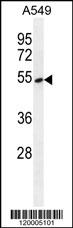
EAPII Antibody (C-term) western blot analysis in A549 cell line lysates (35ug/lane).This demonstrates the EAPII antibody detected the EAPII protein (arrow).Application
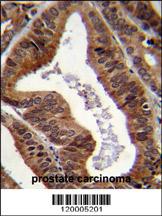
EAPII Antibody (C-term) immunohistochemistry analysis in formalin fixed and paraffin embedded human prostate carcinoma followed by peroxidase conjugation of the secondary antibody and DAB staining.This data demonstrates the use of EAPII Antibody (C-term) for immunohistochemistry. Clinical relevance has not been evaluated.Application
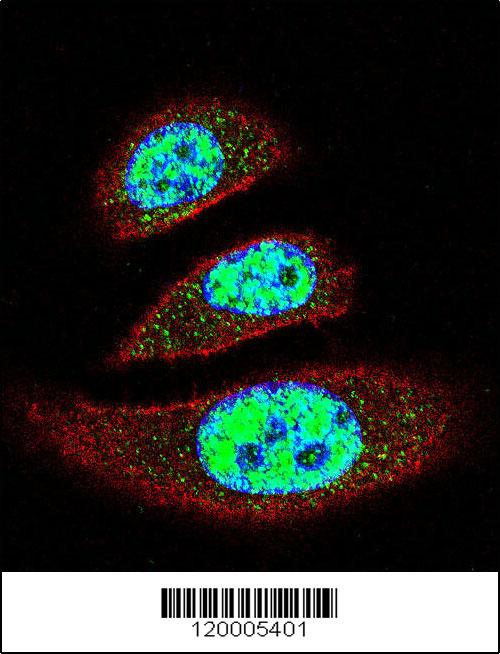
Confocal immunofluorescent analysis of EAPII Antibody (C-term)(Cat#AP11233b) with A549 cell followed by Alexa Fluor 488-conjugated goat anti-rabbit lgG (green).Actin filaments have been labeled with Alexa Fluor 555 phalloidin (red). DAPI was used to stain the cell nuclear (blue).Application
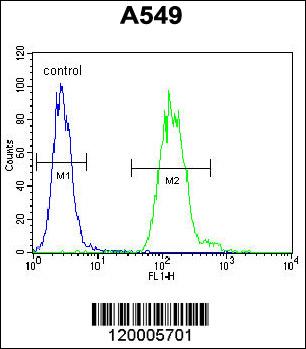
EAPII Antibody (C-term) flow cytometric analysis of A549 cells (right histogram) compared to a negative control cell (left histogram).FITC-conjugated goat-anti-rabbit secondary antibodies were used for the analysis.| Product Name | EAPII Antibody (C-term) |
|---|---|
| Antibody Type | Primary Antibodies |
| Clonality | Polyclonal |
|---|---|
| Isotype | Ig |
| Host Species | Rabbit |
| Tested Applications | WBIHCIFFC |
| WB:1:100~500 IHC |
|
| Species Reactivity | Human |
| Concentration | 1mg/ml |
| Gene Synonyms | EAP2, TTRAP |
|---|---|
| Alternative Names | TDP2 EAP2 TTRAP Tyrosyl-DNA phosphodiesterase 2 5'-tyrosyl-DNA phosphodiesterase ETS1-associated protein 2 ETS1-associated protein II TRAF and TNF receptor-associated protein |
| Molecular Weight(MW) | 40930 Da |
| Function | DNA repair enzyme that can remove a variety of covalent adducts from DNA through hydrolysis of a 5'-phosphodiester bond, giving rise to DNA with a free 5' phosphate. Catalyzes the hydrolysis of dead-end complexes between DNA and the topoisomerase 2 (TOP2) active site tyrosine residue. Hydrolyzes 5'- phosphoglycolates on protruding 5' ends on DNA double-strand breaks (DSBs) due to DNA damage by radiation and free radicals The 5'-tyrosyl DNA phosphodiesterase activity can enable the repair of TOP2-induced DSBs without the need for nuclease activity, creating a 'clean' DSB with 5'-phosphate termini that are ready for ligation. Has preference for single-stranded DNA or duplex DNA with a 4 base pair overhang as substrate. Has also 3'- tyrosyl DNA phosphodiesterase activity, but less efficiently and much slower than TDP1. Constitutes the major if not only 5'- tyrosyl-DNA phosphodiesterase in cells. Also acts as a 5'-tyrosyl- RNA phosphodiesterase following picornavirus infection: its activity is hijacked by picornavirus and acts by specifically cleaving the protein-RNA covalent linkage generated during the viral genomic RNA replication steps of a picornavirus infection, without impairing the integrity of viral RNA. Also acts as an adapter by participating to the specific activation of MAP3K7/TAK1 in response to TGF-beta: associates with components of the TGF- beta receptor-TRAF6-TAK1 signaling module and promotes their ubiquitination dependent complex formation. Involved in non- canonical TGF-beta induced signaling routes. May also act as a negative regulator of ETS1 and may inhibit NF-kappa-B activation Acts as a regulator of ribosome biogenesis following stress |
| Tissue Specificity | Widely expressed. |
| Cellular Localization | Nucleus. Nucleus, PML body. Nucleus, nucleolus. Cytoplasm. Note=Localizes to nucleolar cavities following stress; localization to nucleolus is dependent on PML protein. In case of infection by picornavirus, relocalizes to cytoplasmic sites distinct from those containing viral proteins associated with RNA replication or encapsidation |
Application
EAPII Antibody (C-term) western blot analysis in A549 cell line lysates (35ug/lane).This demonstrates the EAPII antibody detected the EAPII protein (arrow).
Application
EAPII Antibody (C-term) immunohistochemistry analysis in formalin fixed and paraffin embedded human prostate carcinoma followed by peroxidase conjugation of the secondary antibody and DAB staining.This data demonstrates the use of EAPII Antibody (C-term) for immunohistochemistry. Clinical relevance has not been evaluated.
Application
Confocal immunofluorescent analysis of EAPII Antibody (C-term)(Cat#AP11233b) with A549 cell followed by Alexa Fluor 488-conjugated goat anti-rabbit lgG (green).Actin filaments have been labeled with Alexa Fluor 555 phalloidin (red). DAPI was used to stain the cell nuclear (blue).
Application
EAPII Antibody (C-term) flow cytometric analysis of A549 cells (right histogram) compared to a negative control cell (left histogram).FITC-conjugated goat-anti-rabbit secondary antibodies were used for the analysis.| Application Notes | WB:1:100~500 IHC |
|---|
| Form | Liquid |
|---|---|
| Storage Instructions | For short-term storage, store at 4° C. For long-term storage, aliquot and store at -20ºC or below. Avoid multiple freeze-thaw cycles. |
| Storage Buffer | Purified polyclonal antibody supplied in PBS with 0.09% (W/V) sodium azide. This antibody is purified through a protein A column, followed by peptide affinity purification. |


