Application
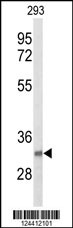
Western blot analysis of EFNB3 Antibody (Center) in 293 cell line lysates (35ug/lane). EFNB3 (arrow) was detected using the purified Pab.| Product Name | EFNB3 Antibody (Center) |
|---|---|
| Antibody Type | Primary Antibodies |
| Clonality | Polyclonal |
|---|---|
| Isotype | Ig |
| Host Species | Rabbit |
| Tested Applications | WB |
| WB:1:100~500 |
|
| Species Reactivity | Human |
| Concentration | 1mg/ml |
| Gene Synonyms | EPLG8, LERK8 |
|---|---|
| Alternative Names | EFNB3 EPLG8 LERK8 Ephrin-B3 EPH-related receptor transmembrane ligand ELK-L3 EPH-related receptor tyrosine kinase ligand 8 |
| Molecular Weight(MW) | 35835 Da |
| Function | Cell surface transmembrane ligand for Eph receptors, a family of receptor tyrosine kinases which are crucial for migration, repulsion and adhesion during neuronal, vascular and epithelial development. Binds promiscuously Eph receptors residing on adjacent cells, leading to contact-dependent bidirectional signaling into neighboring cells. The signaling pathway downstream of the receptor is referred to as forward signaling while the signaling pathway downstream of the ephrin ligand is referred to as reverse signaling. May play a pivotal role in forebrain function. Binds to, and induce the collapse of, commissural axons/growth cones in vitro. May play a role in constraining the orientation of longitudinally projecting axons (By similarity) |
| Tissue Specificity | Highly expressed in brain; expressed in embryonic floor plate, roof plate and hindbrain segments |
| Cellular Localization | Membrane; Single-pass type I membrane protein |
| Entrez Gene | 1949 |
|---|
Application
Western blot analysis of EFNB3 Antibody (Center) in 293 cell line lysates (35ug/lane). EFNB3 (arrow) was detected using the purified Pab.| Application Notes | WB:1:100~500 |
|---|
| Form | Liquid |
|---|---|
| Storage Instructions | For short-term storage, store at 4° C. For long-term storage, aliquot and store at -20ºC or below. Avoid multiple freeze-thaw cycles. |
| Storage Buffer | Purified polyclonal antibody supplied in PBS with 0.09% (W/V) sodium azide. This antibody is purified through a protein A column, followed by peptide affinity purification. |


