Application
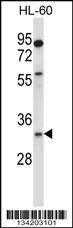
EGLN3 Antibody (C-term) western blot analysis in HL-60 cell line lysates (35ug/lane).This demonstrates the EGLN3 antibody detected the EGLN3 protein (arrow).Application
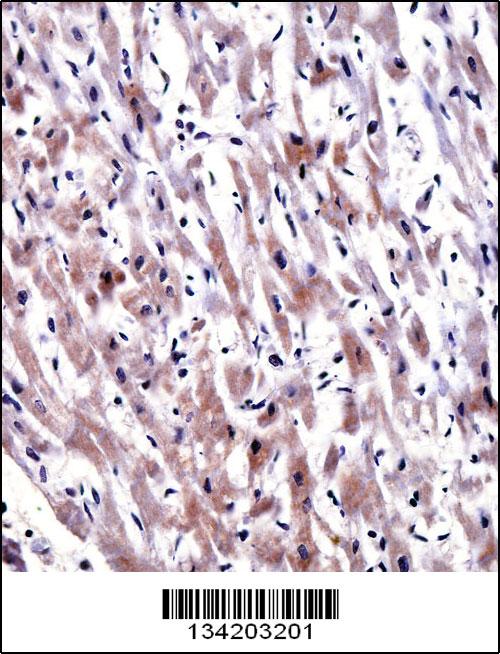
EGLN3 Antibody (C-term) (AP14221b)immunohistochemistry analysis in formalin fixed and paraffin embedded human heart tissue followed by peroxidase conjugation of the secondary antibody and DAB staining.This data demonstrates the use of EGLN3 Antibody (C-term) for immunohistochemistry. Clinical relevance has not been evaluated.| Product Name | EGLN3 Antibody (C-term) |
|---|---|
| Antibody Type | Primary Antibodies |
| Clonality | Polyclonal |
|---|---|
| Isotype | Ig |
| Host Species | Rabbit |
| Tested Applications | WBIHC |
| WB:1:100~500 IHC |
|
| Species Reactivity | Human |
| Concentration | 1mg/ml |
| Alternative Names | EGLN3 Egl nine homolog 3 HPH-1 Hypoxia-inducible factor prolyl hydroxylase 3 Prolyl hydroxylase domain-containing protein 3 |
|---|---|
| Molecular Weight(MW) | 27261 Da |
| Function | Cellular oxygen sensor that catalyzes, under normoxic conditions, the post-translational formation of 4-hydroxyproline in hypoxia-inducible factor (HIF) alpha proteins. Hydroxylates a specific proline found in each of the oxygen-dependent degradation (ODD) domains (N-terminal, NODD, and C-terminal, CODD) of HIF1A Also hydroxylates HIF2A. Has a preference for the CODD site for both HIF1A and HIF2A. Hydroxylation on the NODD site by EGLN3 appears to require prior hydroxylation on the CODD site Hydroxylated HIFs are then targeted for proteasomal degradation via the von Hippel-Lindau ubiquitination complex. Under hypoxic conditions, the hydroxylation reaction is attenuated allowing HIFs to escape degradation resulting in their translocation to the nucleus, heterodimerization with HIF1B, and increased expression of hypoxy-inducible genes. EGLN3 is the most important isozyme in limiting physiological activation of HIFs (particularly HIF2A) in hypoxia. Also hydroxylates PKM in hypoxia, limiting glycolysis Under normoxia, hydroxylates and regulates the stability of ADRB2 Regulator of cardiomyocyte and neuronal apoptosis. In cardiomyocytes, inhibits the anti-apoptotic effect of BCL2 by disrupting the BAX-BCL2 complex. In neurons, has a NGF-induced proapoptotic effect, probably through regulating CASP3 activity Also essential for hypoxic regulation of neutrophilic inflammation. Plays a crucial role in DNA damage response (DDR) by hydroxylating TELO2, promoting its interaction with ATR which is required for activation of the ATR/CHK1/p53 pathway |
| Tissue Specificity | Widely expressed at low levels. Expressed at higher levels in adult heart (cardiac myocytes, aortic endothelial cells and coronary artery smooth muscle), lung and placenta, and in fetal spleen, heart and skeletal muscle. Also expressed in pancreas. Localized to pancreatic acini and islet cells |
| Cellular Localization | Nucleus. Cytoplasm. Note=Colocalizes with WDR83 in the cytoplasm (By similarity) |
| Entrez Gene | 112399 |
|---|---|
| Nucleotide Accession | NP_071356.1 |
Application
EGLN3 Antibody (C-term) western blot analysis in HL-60 cell line lysates (35ug/lane).This demonstrates the EGLN3 antibody detected the EGLN3 protein (arrow).
Application
EGLN3 Antibody (C-term) (AP14221b)immunohistochemistry analysis in formalin fixed and paraffin embedded human heart tissue followed by peroxidase conjugation of the secondary antibody and DAB staining.This data demonstrates the use of EGLN3 Antibody (C-term) for immunohistochemistry. Clinical relevance has not been evaluated.| Application Notes | WB:1:100~500 IHC |
|---|
| Form | Liquid |
|---|---|
| Storage Instructions | For short-term storage, store at 4° C. For long-term storage, aliquot and store at -20ºC or below. Avoid multiple freeze-thaw cycles. |
| Storage Buffer | Purified polyclonal antibody supplied in PBS with 0.09% (W/V) sodium azide. This antibody is purified through a protein A column, followed by peptide affinity purification. |


