Application
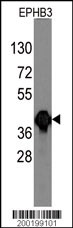
Western blot analysis of anti-EPHB3 Monoclonal Antibody (Cat.#AM7624a) by EPHB3 recombinant protein (Fragment). EPHB3 (Fragment) protein (arrow) was detected using the ascites Mab. (1:2000)| Product Name | EPHB3 Antibody |
|---|---|
| Antibody Type | Primary Antibodies |
| Clonality | Monoclonal |
|---|---|
| Isotype | IgG1 |
| Clone Number | 50CT97.1.9 |
| Host Species | Mouse |
| Tested Applications | WB |
| WB:1:2000 |
|
| Species Reactivity | Human |
| Concentration | 1mg/ml |
| Gene Synonyms | ETK2, HEK2, TYRO6 |
|---|---|
| Alternative Names | EPHB3 ETK2 HEK2 TYRO6 Ephrin type-B receptor 3 EPH-like tyrosine kinase 2 Embryonic kinase 2 Tyrosine-protein kinase TYRO6 |
| Molecular Weight(MW) | 110330 Da |
| Function | Receptor tyrosine kinase which binds promiscuously transmembrane ephrin-B family ligands residing on adjacent cells, leading to contact-dependent bidirectional signaling into neighboring cells. The signaling pathway downstream of the receptor is referred to as forward signaling while the signaling pathway downstream of the ephrin ligand is referred to as reverse signaling. Generally has an overlapping and redundant function with EPHB2. Like EPHB2, functions in axon guidance during development regulating for instance the neurons forming the corpus callosum and the anterior commissure, 2 major interhemispheric connections between the temporal lobes of the cerebral cortex Beside its role in axon guidance plays also an important redundant role with other ephrin-B receptors in development and maturation of dendritic spines and the formation of excitatory synapses Controls other aspects of development through regulation of cell migration and positioning. This includes angiogenesis, palate development and thymic epithelium development for instance Forward and reverse signaling through the EFNB2/EPHB3 complex also regulate migration and adhesion of cells that tubularize the urethra and septate the cloaca. Finally, plays an important role in intestinal epithelium differentiation segregating progenitor from differentiated cells in the crypt |
| Tissue Specificity | Ubiquitous. |
| Cellular Localization | Cell membrane; Single-pass type I membrane protein. Cell projection, dendrite (By similarity) |
| Entrez Gene | 2049 |
|---|
Application
Western blot analysis of anti-EPHB3 Monoclonal Antibody (Cat.#AM7624a) by EPHB3 recombinant protein (Fragment). EPHB3 (Fragment) protein (arrow) was detected using the ascites Mab. (1:2000)| Application Notes | WB:1:2000 |
|---|
| Form | Liquid |
|---|---|
| Storage Instructions | For short-term storage, store at 4° C. For long-term storage, aliquot and store at -20ºC or below. Avoid multiple freeze-thaw cycles. |
| Storage Buffer | Mouse monoclonal antibody supplied in crude ascites with 0.09% (W/V) sodium azide. |


