Application
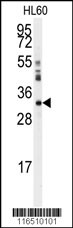
Western blot analysis of anti-EXOSC3 Antibody (C-term) in HL60 cell line lysates (35ug/lane). EXOSC3 (arrow) was detected using the purified Pab.| Product Name | EXOSC3 Antibody (C-term) |
|---|---|
| Antibody Type | Primary Antibodies |
| Antigen Alias | EXOSC3; RRP40; Exosome complex component RRP40; Exosome component 3; Ribosomal RNA-processing protein 40; p10 |
| Clonality | Polyclonal |
|---|---|
| Isotype | Ig |
| Host Species | Rabbit |
| Tested Applications | WB |
| WB:1:50~100 |
|
| Species Reactivity | Human |
| Concentration | 1mg/ml |
| Gene Synonyms | RRP40 |
|---|---|
| Alternative Names | EXOSC3 RRP40 Exosome complex component RRP40 Exosome component 3 Ribosomal RNA-processing protein 40 p10 |
| Molecular Weight(MW) | 29572 Da |
| Function | Non-catalytic component of the RNA exosome complex which has 3'->5' exoribonuclease activity and participates in a multitude of cellular RNA processing and degradation events. In the nucleus, the RNA exosome complex is involved in proper maturation of stable RNA species such as rRNA, snRNA and snoRNA, in the elimination of RNA processing by-products and non-coding 'pervasive' transcripts, such as antisense RNA species and promoter-upstream transcripts (PROMPTs), and of mRNAs with processing defects, thereby limiting or excluding their export to the cytoplasm. The RNA exosome may be involved in Ig class switch recombination (CSR) and/or Ig variable region somatic hypermutation (SHM) by targeting AICDA deamination activity to transcribed dsDNA substrates. In the cytoplasm, the RNA exosome complex is involved in general mRNA turnover and specifically degrades inherently unstable mRNAs containing AU-rich elements (AREs) within their 3' untranslated regions, and in RNA surveillance pathways, preventing translation of aberrant mRNAs It seems to be involved in degradation of histone mRNA. The catalytic inactive RNA exosome core complex of 9 subunits (Exo-9) is proposed to play a pivotal role in the binding and presentation of RNA for ribonucleolysis, and to serve as a scaffold for the association with catalytic subunits and accessory proteins or complexes. EXOSC3 as peripheral part of the Exo-9 complex stabilizes the hexameric ring of RNase PH-domain subunits through contacts with EXOSC9 and EXOSC5 |
| Tissue Specificity | This EXOSC3 antibody is generated from rabbits immunized with a KLH conjugated synthetic peptide between 246~275 amino acids from the C-terminal region of human EXOSC3. |
| Cellular Localization | Cytoplasm. Nucleus, nucleolus. Nucleus. |
| Entrez Gene | 51010 |
|---|
Application
Western blot analysis of anti-EXOSC3 Antibody (C-term) in HL60 cell line lysates (35ug/lane). EXOSC3 (arrow) was detected using the purified Pab.| Application Notes | WB:1:50~100 |
|---|
| Form | Liquid |
|---|---|
| Storage Instructions | For short-term storage, store at 4° C. For long-term storage, aliquot and store at -20ºC or below. Avoid multiple freeze-thaw cycles. |
| Storage Buffer | Purified polyclonal antibody supplied in PBS with 0.09% (W/V) sodium azide. This antibody is prepared by Saturated Ammonium Sulfate (SAS) precipitation followed by dialysis against PBS. |


