Application
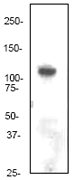
A. Western blot analysis on Jurkat cell lysate using anti-Pyk2 (N-term) RabMAb (Cat. #AJ1286b), dilution 1:5,000Application
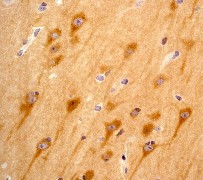
B. Immunohistochemical analysis of paraffin-embedded human normal brain tissue using anti-Pyk2 (N-term) RabMAb (Cat. #AJ1286b).Application
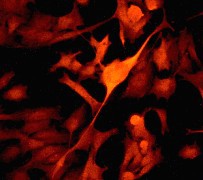
C. Immunofluorescent staining of PC12 cells using anti-Pyk2 (N-term) RabMAb (Cat. #AJ1286b).| Product Name | FAK2/Pyk2 Antibody (N-term) |
|---|---|
| Antibody Type | Primary Antibodies |
| Antigen Alias | PTK2B, FAK2, PYK2, RAFTK, Protein tyrosine kinase 2 beta, Related adhesion focal tyrosine kinase |
| Clonality | Monoclonal |
|---|---|
| Clone Number | YE353 |
| Host Species | Rabbit |
| Tested Applications | WBIHCIF |
| WB:1:500 IHC |
|
| Species Reactivity | Human |
| Concentration | 1mg/ml |
| Gene Synonyms | FAK2 PYK2 RAFTK |
|---|---|
| Alternative Names | PTK2B FAK2 PYK2 RAFTK Protein tyrosine kinase 2 beta Related adhesion focal tyrosine kinase |
| Molecular Weight(MW) | 115875 Da |
| Function | Non-receptor protein-tyrosine kinase that regulates reorganization of the actin cytoskeleton, cell polarization, cell migration, adhesion, spreading and bone remodeling. Plays a role in the regulation of the humoral immune response, and is required for normal levels of marginal B-cells in the spleen and normal migration of splenic B-cells. Required for normal macrophage polarization and migration towards sites of inflammation Regulates cytoskeleton rearrangement and cell spreading in T- cells, and contributes to the regulation of T-cell responses Promotes osteoclastic bone resorption; this requires both PTK2B/PYK2 and SRC. May inhibit differentiation and activity of osteoprogenitor cells. Functions in signaling downstream of integrin and collagen receptors, immune receptors, G-protein coupled receptors (GPCR), cytokine, chemokine and growth factor receptors, and mediates responses to cellular stress. Forms multisubunit signaling complexes with SRC and SRC family members upon activation; this leads to the phosphorylation of additional tyrosine residues, creating binding sites for scaffold proteins, effectors and substrates. Regulates numerous signaling pathways Promotes activation of phosphatidylinositol 3-kinase and of the AKT1 signaling cascade. Promotes activation of NOS3. Regulates production of the cellular messenger cGMP. Promotes activation of the MAP kinase signaling cascade, including activation of MAPK1/ERK2, MAPK3/ERK1 and MAPK8/JNK1. Promotes activation of Rho family GTPases, such as RHOA and RAC1. Recruits the ubiquitin ligase MDM2 to P53/TP53 in the nucleus, and thereby regulates P53/TP53 activity, P53/TP53 ubiquitination and proteasomal degradation. Acts as a scaffold, binding to both PDPK1 and SRC, thereby allowing SRC to phosphorylate PDPK1 at 'Tyr-9, 'Tyr-373', and 'Tyr-376'. Promotes phosphorylation of NMDA receptors by SRC family members, and thereby contributes to the regulation of NMDA receptor ion channel activity and intracellular Ca(2+) levels. May also regulate potassium ion transport by phosphorylation of potassium channel subunits. Phosphorylates SRC; this increases SRC kinase activity. Phosphorylates ASAP1, NPHP1, KCNA2 and SHC1 Promotes phosphorylation of ASAP2, RHOU and PXN; this requires both SRC and PTK2/PYK2 |
| Tissue Specificity | Most abundant in the brain, with highest levels in amygdala and hippocampus. Low levels in kidney (at protein level). Also expressed in spleen and lymphocytes |
| Cellular Localization | Cytoplasm. Cytoplasm, perinuclear region. Cell membrane; Peripheral membrane protein; Cytoplasmic side. Cell junction, focal adhesion. Cell projection, lamellipodium Cytoplasm, cell cortex. Nucleus. Note=Interaction with NPHP1 induces the membrane-association of the kinase. Colocalizes with integrins at the cell periphery |
| Entrez Gene | 2185 |
|---|
Application
A. Western blot analysis on Jurkat cell lysate using anti-Pyk2 (N-term) RabMAb (Cat. #AJ1286b), dilution 1:5,000
Application
B. Immunohistochemical analysis of paraffin-embedded human normal brain tissue using anti-Pyk2 (N-term) RabMAb (Cat. #AJ1286b).
Application
C. Immunofluorescent staining of PC12 cells using anti-Pyk2 (N-term) RabMAb (Cat. #AJ1286b).| Application Notes | WB:1:500 IHC |
|---|
| Form | Liquid |
|---|---|
| Storage Instructions | For short-term storage, store at 4° C. For long-term storage, aliquot and store at -20ºC or below. Avoid multiple freeze-thaw cycles. |
| Storage Buffer | 50 mM Tris-Glycine (pH 7.4), 0.15 M NaCl, 40% Glycerol, 0.01% sodium azide and 0.05% BSA. |


