Application
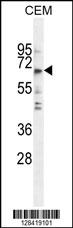
FLJ44817 Antibody (C-term) western blot analysis in CEM cell line lysates (35ug/lane).This demonstrates the FLJ44817 antibody detected the FLJ44817 protein (arrow).Application
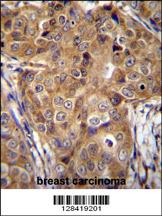
FLJ44817 Antibody (C-term) immunohistochemistry analysis in formalin fixed and paraffin embedded human breast carcinoma followed by peroxidase conjugation of the secondary antibody and DAB staining.This data demonstrates the use of FLJ44817 Antibody (C-term) for immunohistochemistry. Clinical relevance has not been evaluated.Application
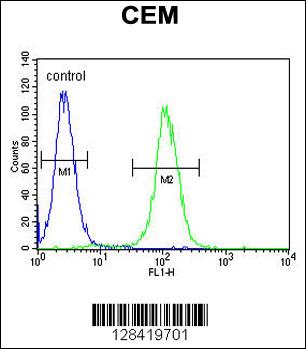
FLJ44817 Antibody (C-term) flow cytometric analysis of CEM cells (right histogram) compared to a negative control cell (left histogram).FITC-conjugated goat-anti-rabbit secondary antibodies were used for the analysis.| Product Name | FLJ44817 Antibody (C-term) |
|---|---|
| Antibody Type | Primary Antibodies |
| Antigen Alias | PLEKHD1; Pleckstrin homology domain-containing family D member 1 |
| Clonality | Polyclonal |
|---|---|
| Isotype | Ig |
| Host Species | Rabbit |
| Tested Applications | WBIHCFC |
| WB:1:100~500 IHC |
|
| Species Reactivity | Human |
| Concentration | 1mg/ml |
| Alternative Names | PLEKHD1 Pleckstrin homology domain-containing family D member 1 |
|---|---|
| Molecular Weight(MW) | 59203 Da |
| Tissue Specificity | This FLJ44817 antibody is generated from rabbits immunized with a KLH conjugated synthetic peptide between 467-497 amino acids from the C-terminal region of human FLJ44817. |
| Entrez Gene | 400224 |
|---|---|
| Nucleotide Accession | B9EJC2 NP_001154970.1 |
Application
FLJ44817 Antibody (C-term) western blot analysis in CEM cell line lysates (35ug/lane).This demonstrates the FLJ44817 antibody detected the FLJ44817 protein (arrow).
Application
FLJ44817 Antibody (C-term) immunohistochemistry analysis in formalin fixed and paraffin embedded human breast carcinoma followed by peroxidase conjugation of the secondary antibody and DAB staining.This data demonstrates the use of FLJ44817 Antibody (C-term) for immunohistochemistry. Clinical relevance has not been evaluated.
Application
FLJ44817 Antibody (C-term) flow cytometric analysis of CEM cells (right histogram) compared to a negative control cell (left histogram).FITC-conjugated goat-anti-rabbit secondary antibodies were used for the analysis.| Application Notes | WB:1:100~500 IHC |
|---|
| Form | Liquid |
|---|---|
| Storage Instructions | For short-term storage, store at 4° C. For long-term storage, aliquot and store at -20ºC or below. Avoid multiple freeze-thaw cycles. |
| Storage Buffer | Purified polyclonal antibody supplied in PBS with 0.09% (W/V) sodium azide. This antibody is purified through a protein A column, followed by peptide affinity purification. |


