Application
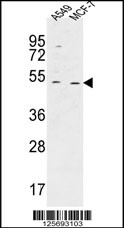
HAUS4 Antibody (C-term) western blot analysis in A549,MCF-7 cell line lysates (35ug/lane).This demonstrates the HAUS4 antibody detected the HAUS4 protein (arrow).Application
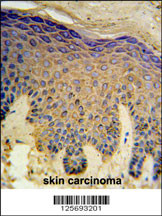
HAUS4 Antibody (C-term) IHC analysis in formalin fixed and paraffin embedded skin carcinoma followed by peroxidase conjugation of the secondary antibody and DAB staining. This data demonstrates the use of the HAUS4 Antibody (C-term) for immunohistochemistry. Clinical relevance has not been evaluated.| Product Name | HAUS4 Antibody (C-term) |
|---|---|
| Antibody Type | Primary Antibodies |
| Antigen Alias | HAUS4; C14orf94; HAUS augmin-like complex subunit 4 |
| Clonality | Polyclonal |
|---|---|
| Isotype | Ig |
| Host Species | Rabbit |
| Tested Applications | WBIHC |
| WB:1:100~500 IHC |
|
| Species Reactivity | Human |
| Concentration | 1mg/ml |
| Gene Synonyms | C14orf94 |
|---|---|
| Alternative Names | HAUS4 C14orf94 HAUS augmin-like complex subunit 4 |
| Molecular Weight(MW) | 42400 Da |
| Function | Contributes to mitotic spindle assembly, maintenance of centrosome integrity and completion of cytokinesis as part of the HAUS augmin-like complex |
| Tissue Specificity | This HAUS4 antibody is generated from rabbits immunized with a KLH conjugated synthetic peptide between 296-326 amino acids from the C-terminal region of human HAUS4. |
| Cellular Localization | Cytoplasm, cytoskeleton, centrosome. Cytoplasm, cytoskeleton, spindle. Note=Localizes to interphase centrosomes and to mitotic spindle microtubules |
| Entrez Gene | 54930 |
|---|
Application
HAUS4 Antibody (C-term) western blot analysis in A549,MCF-7 cell line lysates (35ug/lane).This demonstrates the HAUS4 antibody detected the HAUS4 protein (arrow).
Application
HAUS4 Antibody (C-term) IHC analysis in formalin fixed and paraffin embedded skin carcinoma followed by peroxidase conjugation of the secondary antibody and DAB staining. This data demonstrates the use of the HAUS4 Antibody (C-term) for immunohistochemistry. Clinical relevance has not been evaluated.| Application Notes | WB:1:100~500 IHC |
|---|
| Form | Liquid |
|---|---|
| Storage Instructions | For short-term storage, store at 4° C. For long-term storage, aliquot and store at -20ºC or below. Avoid multiple freeze-thaw cycles. |
| Storage Buffer | Purified polyclonal antibody supplied in PBS with 0.09% (W/V) sodium azide. This antibody is purified through a protein A column, followed by peptide affinity purification. |


