Application
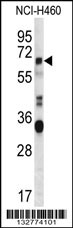
HERV-FRD Antibody (N-term) western blot analysis in NCI-H460 cell line lysates (35ug/lane).This demonstrates the HERV-FRD antibody detected the HERV-FRD protein (arrow).| Product Name | HERV-FRD Antibody (N-term) |
|---|---|
| Antibody Type | Primary Antibodies |
| Antigen Alias | ERVFRD-1; ERVFRDE1; HERV-FRD_6p24.1 provirus ancestral Env polyprotein; Endogenous retrovirus group FRD member 1; Envelope polyprotein; HERV-FRD; Syncytin-2; Surface protein; Transmembrane protein |
| Clonality | Polyclonal |
|---|---|
| Isotype | Ig |
| Host Species | Rabbit |
| Tested Applications | WB |
| WB:1:100~500 |
|
| Species Reactivity | Human |
| Concentration | 1mg/ml |
| Gene Synonyms | ERVFRDE1 |
|---|---|
| Alternative Names | ERVFRD-1 ERVFRDE1 HERV-FRD_6p24.1 provirus ancestral Env polyprotein Endogenous retrovirus group FRD member 1 Envelope polyprotein HERV-FRD Syncytin-2 Surface protein Transmembrane protein |
| Molecular Weight(MW) | 59523 Da |
| Function | Retroviral envelope proteins mediate receptor recognition and membrane fusion during early infection. Endogenous envelope proteins may have kept, lost or modified their original function during evolution. This endogenous envelope protein has retained its original fusogenic properties. Can make pseudotypes with MLV, HIV-1 or SIV-1 virions and confer infectivity TM anchors the envelope heterodimer to the viral membrane through one transmembrane domain. The other hydrophobic domain, called fusion peptide, mediates fusion of the viral membrane with the target cell membrane (By similarity) |
| Tissue Specificity | Expressed at higher level in placenta. Expressed at lower level in adrenal, bone marrow, brain, breast, colon, kidney, lung, ovary, peripheral blood lymphocytes, prostate, skin, spleen, testis, thymus, thyroid, trachea |
| Cellular Localization | Virion. |
| Entrez Gene | 405754 |
|---|---|
| Nucleotide Accession | NP_997465.1 |
Application
HERV-FRD Antibody (N-term) western blot analysis in NCI-H460 cell line lysates (35ug/lane).This demonstrates the HERV-FRD antibody detected the HERV-FRD protein (arrow).| Application Notes | WB:1:100~500 |
|---|
| Form | Liquid |
|---|---|
| Storage Instructions | For short-term storage, store at 4° C. For long-term storage, aliquot and store at -20ºC or below. Avoid multiple freeze-thaw cycles. |
| Storage Buffer | Purified polyclonal antibody supplied in PBS with 0.09% (W/V) sodium azide. This antibody is purified through a protein A column, followed by peptide affinity purification. |


