Application
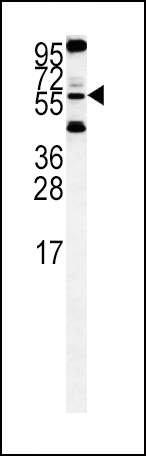
HtrA1-K396 western blot analysis in Hela cell line lysates (35ug/lane).This demonstrates the HtrA1 antibody detected the HtrA1 protein (arrow).| Product Name | HtrA1 Antibody (C-term) |
|---|---|
| Antibody Type | Primary Antibodies |
| Antigen Alias | HTRA1; HTRA; PRSS11; Serine protease HTRA1; High-temperature requirement A serine peptidase 1; L56; Serine protease 11 |
| Clonality | Polyclonal |
|---|---|
| Isotype | Ig |
| Host Species | Rabbit |
| Tested Applications | WB |
| WB:1:100~500 |
|
| Species Reactivity | Human |
| Concentration | 1mg/ml |
| Gene Synonyms | HTRA PRSS11 |
|---|---|
| Alternative Names | HTRA1 HTRA PRSS11 Serine protease HTRA1 High-temperature requirement A serine peptidase 1 L56 Serine protease 11 |
| Molecular Weight(MW) | 51287 Da |
| Function | Serine protease with a variety of targets, including extracellular matrix proteins such as fibronectin. HTRA1-generated fibronectin fragments further induce synovial cells to up-regulate MMP1 and MMP3 production. May also degrade proteoglycans, such as aggrecan, decorin and fibromodulin. Through cleavage of proteoglycans, may release soluble FGF-glycosaminoglycan complexes that promote the range and intensity of FGF signals in the extracellular space. Regulates the availability of insulin-like growth factors (IGFs) by cleaving IGF-binding proteins. Inhibits signaling mediated by TGF-beta family members. This activity requires the integrity of the catalytic site, although it is unclear whether TGF-beta proteins are themselves degraded. By acting on TGF-beta signaling, may regulate many physiological processes, including retinal angiogenesis and neuronal survival and maturation during development. Intracellularly, degrades TSC2, leading to the activation of TSC2 downstream targets |
| Tissue Specificity | Widely expressed, with strongest expression in placenta (at protein level). Secreted by synovial fibroblasts. Up- regulated in osteoarthritis and rheumatoid arthritis synovial fluids and cartilage as compared with non-arthritic (at protein level) |
| Cellular Localization | Secreted. Cytoplasm, cytosol. Note=Predominantly secreted. Also found associated with the plasma membrane |
| Entrez Gene | 5654 |
|---|
Application
HtrA1-K396 western blot analysis in Hela cell line lysates (35ug/lane).This demonstrates the HtrA1 antibody detected the HtrA1 protein (arrow).| Application Notes | WB:1:100~500 |
|---|
| Form | Liquid |
|---|---|
| Storage Instructions | For short-term storage, store at 4° C. For long-term storage, aliquot and store at -20ºC or below. Avoid multiple freeze-thaw cycles. |
| Storage Buffer | Purified polyclonal antibody supplied in PBS with 0.09% (W/V) sodium azide. This antibody is purified through a protein G column, eluted with high and low pH buffers and neutralized immediately, followed by dialysis against PBS. |


