Application
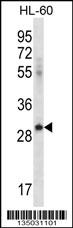
ICOSLG Antibody (C-term) western blot analysis in HL-60 cell line lysates (35ug/lane).This demonstrates the ICOSLG antibody detected the ICOSLG protein (arrow).| Product Name | ICOSLG Antibody (C-term) |
|---|---|
| Antibody Type | Primary Antibodies |
| Antigen Alias | ICOSLG; B7H2; B7RP1; ICOSL; KIAA0653; ICOS ligand; B7 homolog 2; B7-like protein Gl50; B7-related protein 1; CD_antigen=CD275; Flags: Precursor |
| Clonality | Polyclonal |
|---|---|
| Isotype | Ig |
| Host Species | Rabbit |
| Tested Applications | WB |
| WB:1:100~500 |
|
| Species Reactivity | Human |
| Concentration | 1mg/ml |
| Gene Synonyms | B7H2 B7RP1 ICOSL KIAA0653 |
|---|---|
| Alternative Names | ICOSLG B7H2 B7RP1 ICOSL KIAA0653 ICOS ligand B7 homolog 2 B7-like protein Gl50 B7-related protein 1 CD_antigen=CD275 Flags: Precursor |
| Molecular Weight(MW) | 33349 Da |
| Function | Ligand for the T-cell-specific cell surface receptor ICOS. Acts as a costimulatory signal for T-cell proliferation and cytokine secretion; induces also B-cell proliferation and differentiation into plasma cells. Could play an important role in mediating local tissue responses to inflammatory conditions, as well as in modulating the secondary immune response by co- stimulating memory T-cell function (By similarity) |
| Tissue Specificity | Isoform 1 is widely expressed (brain, heart, kidney, liver, lung, pancreas, placenta, skeletal muscle, bone marrow, colon, ovary, prostate, testis, lymph nodes, leukocytes, spleen, thymus and tonsil), while isoform 2 is detected only in lymph nodes, leukocytes and spleen. Expressed on activated monocytes and dendritic cells |
| Cellular Localization | Membrane; Single-pass type I membrane protein (By similarity) |
| Entrez Gene | 23308 |
|---|---|
| Nucleotide Accession | NP_056074.1 |
Application
ICOSLG Antibody (C-term) western blot analysis in HL-60 cell line lysates (35ug/lane).This demonstrates the ICOSLG antibody detected the ICOSLG protein (arrow).| Application Notes | WB:1:100~500 |
|---|
| Form | Liquid |
|---|---|
| Storage Instructions | For short-term storage, store at 4° C. For long-term storage, aliquot and store at -20ºC or below. Avoid multiple freeze-thaw cycles. |
| Storage Buffer | Purified polyclonal antibody supplied in PBS with 0.09% (W/V) sodium azide. This antibody is purified through a protein A column, followed by peptide affinity purification. |


