Application
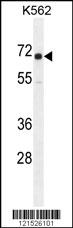
IGF2BP1 Antibody (C-term) western blot analysis in K562 cell line lysates (35ug/lane).This demonstrates the IGF2BP1 antibody detected the IGF2BP1 protein (arrow).Application
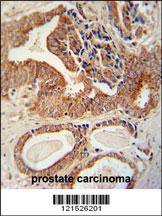
IGF2BP1 antibody (C-term) immunohistochemistry analysis in formalin fixed and paraffin embedded human prostate carcinoma followed by peroxidase conjugation of the secondary antibody and DAB staining. This data demonstrates the use of the IGF2BP1 antibody (C-term) for immunohistochemistry. Clinical relevance has not been evaluated.Application
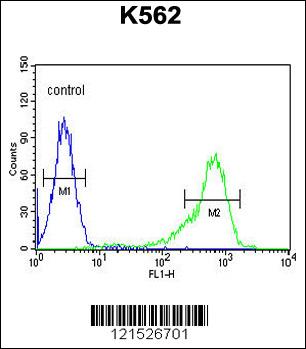
IGF2BP1 Antibody (C-term) flow cytometric analysis of K562 cells (right histogram) compared to a negative control cell (left histogram).FITC-conjugated goat-anti-rabbit secondary antibodies were used for the analysis.| Product Name | IGF2BP1 Antibody (C-term) |
|---|---|
| Antibody Type | Primary Antibodies |
| Antigen Alias | IGF2BP1; CRDBP; VICKZ1; ZBP1; Insulin-like growth factor 2 mRNA-binding protein 1; Coding region determinant-binding protein; IGF-II mRNA-binding protein 1; VICKZ family member 1; Zip code-binding protein 1 |
| Clonality | Polyclonal |
|---|---|
| Isotype | Ig |
| Host Species | Rabbit |
| Tested Applications | WBIHCFC |
| WB:1:100~500 IHC |
|
| Species Reactivity | Human |
| Concentration | 1mg/ml |
| Gene Synonyms | CRDBP VICKZ1 ZBP1 |
|---|---|
| Alternative Names | IGF2BP1 CRDBP VICKZ1 ZBP1 Insulin-like growth factor 2 mRNA-binding protein 1 Coding region determinant-binding protein IGF-II mRNA-binding protein 1 VICKZ family member 1 Zip code-binding protein 1 |
| Molecular Weight(MW) | 63481 Da |
| Function | RNA-binding factor that affects mRNA nuclear export, localization, stability and translation. Component of the CRD- mediated complex that promotes MYC mRNA stabilization. Regulates mRNA stability during the integrated cellular stress response (ISR) in stress granules (SGs). Stabilizes the BTRC/FBW1A mRNA from degradation by disrupting miRNA-dependent interaction with AGO2. Identified in a HCV IRES-mediated translation complex, that enhances translation at the Hepatitis C virus (HCV) RNA-replicon via the internal ribosome entry site (IRES), but does not affect 5'cap-dependent translation. Acts as a HIV-1 retrovirus restriction factor that reduces HIV-1 assembly by inhibiting viral RNA packaging, assembly and processing of HIV-1 GAG protein on cellular membranes. Binds to mRNAs in stress granules (SGs). Binds to the stem-loop IV of the 5'-UTR and to the variable region and the poly(U-C) motif of the 3'-UTR of the HCV RNA-replicon. Binds to the 5'-UTR of the insulin-like growth factor 2 (IGF2) mRNA and regulates its subcellular localization and translation. Binds both to the coding region mRNA stability determinant (CRD) and to AU- rich sequences in the 3'-UTR of the MYC and CD44 mRNAs and stabilizes these mRNAs. Binds to the fourth and fifth exons of the oncofetal H19 and neuron-specific TAU mRNAs and regulates their localizations. Binds to the adenine-rich autoregulatory sequence (ARS) 5'-UTR of the PABPC1 mRNA and is involved in its translational repression. The RNA-binding activity to ARS is stimulated by PABPC1. Binds to the coding sequence region of BTRC/FBW1A mRNA and mediates stabilization of BTRC/FBW1A and MYC mRNAs in response to beta-catenin signaling. Binding to RNA employs a cooperative, sequential mechanism of homo- or heterodimerisation. Also involved in growth or survival of lung- cancer cells. Protects the MYC and MDR-1 mRNAs from cleavage by a endoribonuclease, thus prolonging their stabilities (By similarity). Binds to the 3'-UTR axonal localization signal (ALS) of TAU mRNA (By similarity). Binds to a conserved 54-nucleotide element in the 3'-UTR of the beta actin mRNA known as the 'zipcode' (By similarity). Promotes translocation of the beta- actin mRNA to dendrites (By similarity). May act as a regulator of mRNA transport to activated synapses in response to synaptic activity (By similarity) |
| Tissue Specificity | Expressed in fetal liver, fetal lung, fetal kidney, fetal thymus, fetal placenta, fetal follicles of ovary, gonocytes of testis, oocytes, spermatogonia and semen (at protein level). Expressed in testicular and lung cancer (at protein level). Expressed in kidney, prostate, trachea, testis and lung cancer |
| Cellular Localization | Nucleus. Cytoplasm. Cell projection, lamellipodium. Cell projection, dendrite (By similarity). Cell projection, dendritic spine (By similarity). Note=Localized in cytoplasmic mRNP granules containing untranslated mRNAs. Targeted to stress granules (SGs), but not processing bodies (PBs), during cellular stress. Colocalizes with G3BP1 and TIAL1 in SGs Colocalizes with HIV-1 GAG at the cell edges. Found in lamellipodia of the leading edge, in the perinuclear region, and beneath the plasma membrane. The subcytoplasmic localization is cell specific and regulated by cell contact and growth Colocalized with H19 RNA at lamellipodia. Colocalized with CD44 mRNA in RNP granules. Nuclear export is mediated by XPO1/CRM1. In motile cells, is transported towards the leading edge into the cortical region of the lamellipodia where it is connected to microfilaments (By similarity). Present in the form of granules and into F-actin-rich protrusion of dendrites, spines and subsynaptic sites (By similarity). Colocalizes with beta-actin mRNA in dendrites and spines (By similarity). Exhibited rapid, bidirectional movements in dendrites and spines (By similarity) Neuronal depolarization by KCl induces its rapid efflux from the cell body into dendrites (By similarity) |
| Entrez Gene | 10642 |
|---|---|
| Nucleotide Accession | NP_006537.3 |
Application
IGF2BP1 Antibody (C-term) western blot analysis in K562 cell line lysates (35ug/lane).This demonstrates the IGF2BP1 antibody detected the IGF2BP1 protein (arrow).
Application
IGF2BP1 antibody (C-term) immunohistochemistry analysis in formalin fixed and paraffin embedded human prostate carcinoma followed by peroxidase conjugation of the secondary antibody and DAB staining. This data demonstrates the use of the IGF2BP1 antibody (C-term) for immunohistochemistry. Clinical relevance has not been evaluated.
Application
IGF2BP1 Antibody (C-term) flow cytometric analysis of K562 cells (right histogram) compared to a negative control cell (left histogram).FITC-conjugated goat-anti-rabbit secondary antibodies were used for the analysis.| Application Notes | WB:1:100~500 IHC |
|---|
| Form | Liquid |
|---|---|
| Storage Instructions | For short-term storage, store at 4° C. For long-term storage, aliquot and store at -20ºC or below. Avoid multiple freeze-thaw cycles. |
| Storage Buffer | Purified polyclonal antibody supplied in PBS with 0.09% (W/V) sodium azide. This antibody is purified through a protein A column, followed by peptide affinity purification. |


