Application
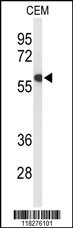
Western blot analysis of IGHM Antibody (C-term) in CEM cell line lysates (35ug/lane). IGHM (arrow) was detected using the purified Pab.| Product Name | IGHM Antibody (C-term) |
|---|---|
| Antibody Type | Primary Antibodies |
| Antigen Alias | IGHM; Ig mu chain C region |
| Clonality | Polyclonal |
|---|---|
| Isotype | Ig |
| Host Species | Rabbit |
| Tested Applications | WB |
| WB:1:50~100 |
|
| Species Reactivity | Human |
| Concentration | 1mg/ml |
| Alternative Names | IGHM Ig mu chain C region |
|---|---|
| Molecular Weight(MW) | 49307 Da |
| Function | IgM antibodies play an important role in primary defense mechanisms. They have been shown to be involved in early recognition of external invaders like bacteria and viruses, cellular waste and modified self, as well as in recognition and elimination of precancerous and cancerous lesions. The membrane- bound form is found in the majority of normal B-cells alongside with IgD. Membrane-bound IgM induces the phosphorylation of CD79A and CD79B by the Src family of protein tyrosine kinases. It may cause death of cells by apoptosis. It is also found in soluble form, which represents about 30% of the total serum immunoglobulins where it is found almost exclusively as a homopentamer. After the antigen binds to the B-cell receptor, the secreted form is secreted in large amounts |
| Tissue Specificity | This IGHM antibody is generated from rabbits immunized with a KLH conjugated synthetic peptide between 412~442 amino acids from the C-terminal region of human IGHM. |
| Cellular Localization | Isoform 1: Secreted. Note=During differentiation, B-lymphocytes switch from expression of membrane- bound IgM to secretion of IgM |
Application
Western blot analysis of IGHM Antibody (C-term) in CEM cell line lysates (35ug/lane). IGHM (arrow) was detected using the purified Pab.| Application Notes | WB:1:50~100 |
|---|
| Form | Liquid |
|---|---|
| Storage Instructions | For short-term storage, store at 4° C. For long-term storage, aliquot and store at -20ºC or below. Avoid multiple freeze-thaw cycles. |
| Storage Buffer | Purified polyclonal antibody supplied in PBS with 0.09% (W/V) sodium azide. This antibody is prepared by Saturated Ammonium Sulfate (SAS) precipitation followed by dialysis against PBS. |


