Application
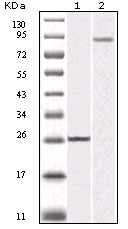
Figure 1: Western blot analysis using anti-IKBKB monoclonal antiobdy against truncated IKBKB recombinant protein(1) and K562 cell lysate(2).| Product Name | IKBKB Antibody |
|---|---|
| Antibody Type | Primary Antibodies |
| Antigen Alias | IKBKB |
| Clonality | Monoclonal |
|---|---|
| Isotype | IgG1 |
| Host Species | Mouse |
| Tested Applications | WB |
| WB:1:500 - 2000. |
|
| Species Reactivity | Human |
| Concentration | 1mg/ml |
| Gene Synonyms | IKKB |
|---|---|
| Alternative Names | IKBKB |
| Molecular Weight(MW) | 86564 Da |
| Function | Serine kinase that plays an essential role in the NF- kappa-B signaling pathway which is activated by multiple stimuli such as inflammatory cytokines, bacterial or viral products, DNA damages or other cellular stresses. Acts as part of the canonical IKK complex in the conventional pathway of NF-kappa-B activation and phosphorylates inhibitors of NF-kappa-B on 2 critical serine residues. These modifications allow polyubiquitination of the inhibitors and subsequent degradation by the proteasome. In turn, free NF-kappa-B is translocated into the nucleus and activates the transcription of hundreds of genes involved in immune response, growth control, or protection against apoptosis. In addition to the NF-kappa-B inhibitors, phosphorylates several other components of the signaling pathway including NEMO/IKBKG, NF-kappa-B subunits RELA and NFKB1, as well as IKK-related kinases TBK1 and IKBKE IKK-related kinase phosphorylations may prevent the overproduction of inflammatory mediators since they exert a negative regulation on canonical IKKs. Also phosphorylates other substrates including NCOA3, BCL10 and IRS1. Within the nucleus, acts as an adapter protein for NFKBIA degradation in UV-induced NF-kappa-B activation |
| Tissue Specificity | Highly expressed in heart, placenta, skeletal muscle, kidney, pancreas, spleen, thymus, prostate, testis and peripheral blood |
| Cellular Localization | Cytoplasm. Nucleus. Membrane raft. Note=Colocalized with DPP4 in membrane rafts |
| Entrez Gene | 3551 |
|---|---|
| Nucleotide Accession | NP_001547.1 |
Application
Figure 1: Western blot analysis using anti-IKBKB monoclonal antiobdy against truncated IKBKB recombinant protein(1) and K562 cell lysate(2).| Application Notes | WB:1:500 - 2000. |
|---|
| Form | Liquid |
|---|---|
| Storage Instructions | For short-term storage, store at 4° C. For long-term storage, aliquot and store at -20ºC or below. Avoid multiple freeze-thaw cycles. |
| Storage Buffer | Purified recombinant fragment of IKBKB expressed in E. Coli. |


