Application
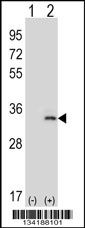
Western blot analysis of IL33 (arrow) using rabbit polyclonal IL33 Antibody (N-term) . 293 cell lysates (2 ug/lane) either nontransfected (Lane 1) or transiently transfected (Lane 2) with the IL33 gene.| Product Name | IL33 Antibody (N-term) |
|---|---|
| Antibody Type | Primary Antibodies |
| Antigen Alias | IL33; C9orf26; IL1F11; NFHEV; Interleukin-33; Interleukin-1 family member 11; Nuclear factor from high endothelial venules |
| Clonality | Polyclonal |
|---|---|
| Isotype | Ig |
| Host Species | Rabbit |
| Tested Applications | WB |
| WB:1:100~500 |
|
| Species Reactivity | Human |
| Concentration | 1mg/ml |
| Gene Synonyms | C9orf26 IL1F11 NFHEV |
|---|---|
| Alternative Names | IL33 C9orf26 IL1F11 NFHEV Interleukin-33 Interleukin-1 family member 11 Nuclear factor from high endothelial venules |
| Molecular Weight(MW) | 30759 Da |
| Function | Cytokine that binds to and signals through IL1RL1/ST2 and its stimulation recruits MYD88, IRAK1, IRAK4, and TRAF6, followed by phosphorylation of MAPK3/ERK1 and/or MAPK1/ERK2, MAPK14, and MAPK8. Induces T-helper type 2-associated cytokines Acts as a chemoattractant tor Th2 cells, and may function as an "alarmin", that amplifies immune responses during tissue injury |
| Tissue Specificity | Expressed at high level in high endothelial venules found in tonsils, Peyer patches and mesenteric lymph nodes. Almost undetectable in placenta |
| Cellular Localization | Nucleus. Chromosome. Cytoplasmic vesicle, secretory vesicle. Secreted. Note=Associates with heterochromatin and mitotic chromosomes. Translocation from the nucleus occurs upon biomechanical strain, depends on an intact microtubule network, and is ATP-dependent |
| Entrez Gene | 90865 |
|---|---|
| Nucleotide Accession | NP_254274.1 |
Application
Western blot analysis of IL33 (arrow) using rabbit polyclonal IL33 Antibody (N-term) . 293 cell lysates (2 ug/lane) either nontransfected (Lane 1) or transiently transfected (Lane 2) with the IL33 gene.| Application Notes | WB:1:100~500 |
|---|
| Form | Liquid |
|---|---|
| Storage Instructions | For short-term storage, store at 4° C. For long-term storage, aliquot and store at -20ºC or below. Avoid multiple freeze-thaw cycles. |
| Storage Buffer | Purified polyclonal antibody supplied in PBS with 0.09% (W/V) sodium azide. This antibody is purified through a protein A column, followed by peptide affinity purification. |


