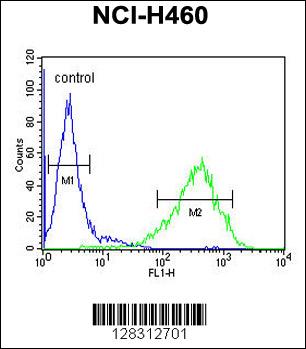
Application
JMY Antibody (N-term) western blot analysis in Y79 cell line lysates (35ug/lane).This demonstrates the JMY antibody detected the JMY protein (arrow).| Product Name | JMY (N-term) |
|---|---|
| Antibody Type | Primary Antibodies |
| Antigen Alias | JMY; Junction-mediating and -regulatory protein |
| Clonality | Polyclonal |
|---|---|
| Isotype | Ig |
| Host Species | Rabbit |
| Tested Applications | WB |
| WB:1:100~500 |
|
| Species Reactivity | Human |
| Concentration | 1mg/ml |
| Alternative Names | JMY Junction-mediating and -regulatory protein |
|---|---|
| Molecular Weight(MW) | 111445 Da |
| Function | Acts both as a nuclear p53/TP53-cofactor and a cytoplasmic regulator of actin dynamics depending on conditions In nucleus, acts as a cofactor that increases p53/TP53 response via its interaction with p300/EP300. Increases p53/TP53-dependent transcription and apoptosis, suggesting an important role in p53/TP53 stress response such as DNA damage. In cytoplasm, acts as a nucleation-promoting factor for both branched and unbranched actin filaments. Activates the Arp2/3 complex to induce branched actin filament networks. Also catalyzes actin polymerization in the absence of Arp2/3, creating unbranched filaments. Contributes to cell motility by controlling actin dynamics. May promote the rapid formation of a branched actin network by first nucleating new mother filaments and then activating Arp2/3 to branch off these filaments. The p53/TP53-cofactor and actin activator activities are regulated via its subcellular location (By similarity) |
| Tissue Specificity | This JMY antibody is generated from rabbits immunized with a KLH conjugated synthetic peptide between 1-29 amino acids from the N-terminal region of human JMY. |
| Cellular Localization | Nucleus (By similarity). Cytoplasm, cytoskeleton. Note=Localizes to the nucleus in most cell types Accumulates in nucleus under DNA damage conditions, increasing p53/TP53 transcription response and reducing its influence on cell motility (By similarity). In primary neutrophils, it colocalizes with actin filaments at the leading edge and is excluded from the nucleus. Localization correlates with motility, because it moves from the nucleus to the cytoplasmic compartment when cells are differentiated from nonmotile cells into highly motile neutrophil- like cells |
| Entrez Gene | 133746 |
|---|---|
| Nucleotide Accession | NP_689618.4 |
Application
JMY Antibody (N-term) western blot analysis in Y79 cell line lysates (35ug/lane).This demonstrates the JMY antibody detected the JMY protein (arrow).| Application Notes | WB:1:100~500 |
|---|
| Form | Liquid |
|---|---|
| Storage Instructions | For short-term storage, store at 4° C. For long-term storage, aliquot and store at -20ºC or below. Avoid multiple freeze-thaw cycles. |
| Storage Buffer | Purified polyclonal antibody supplied in PBS with 0.09% (W/V) sodium azide. This antibody is purified through a protein A column, followed by peptide affinity purification. |


