Application
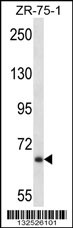
JPH2 Antibody (C-term) western blot analysis in ZR-75-1 cell line lysates (35ug/lane).This demonstrates the JPH2 antibody detected the JPH2 protein (arrow).| Product Name | JPH2 Antibody (C-term) |
|---|---|
| Antibody Type | Primary Antibodies |
| Antigen Alias | JPH2; JP2; Junctophilin-2; Junctophilin type 2 |
| Clonality | Polyclonal |
|---|---|
| Isotype | Ig |
| Host Species | Rabbit |
| Tested Applications | WB |
| WB:1:100~500 |
|
| Species Reactivity | Human |
| Concentration | 1mg/ml |
| Gene Synonyms | JP2 |
|---|---|
| Alternative Names | JPH2 JP2 Junctophilin-2 Junctophilin type 2 |
| Molecular Weight(MW) | 74222 Da |
| Function | Junctophilins contribute to the formation of junctional membrane complexes (JMCs) which link the plasma membrane with the endoplasmic or sarcoplasmic reticulum in excitable cells. Provides a structural foundation for functional cross-talk between the cell surface and intracellular calcium release channels. JPH2 is necessary for proper intracellular Ca(2+) signaling in cardiac myocytes via its involvement in ryanodine receptor-mediated calcium ion release. Contributes to the construction of skeletal muscle triad junctions |
| Tissue Specificity | Specifically expressed in skeletal muscle and heart |
| Cellular Localization | Cell membrane; Peripheral membrane protein (By similarity). Endoplasmic reticulum membrane; Single-pass type IV membrane protein (By similarity). Sarcoplasmic reticulum membrane; Single-pass type IV membrane protein (By similarity) Note=Localized predominantly on the plasma membrane. The transmembrane domain is anchored in endoplasmic/sarcoplasmic reticulum membrane, while the N-terminal part associates with the plasma membrane. In heart cells, it predominantly associates along Z lines within myocytes. In skeletal muscle, it is specifically localized at the junction of A and I bands (By similarity) |
| Entrez Gene | 57158 |
|---|---|
| Nucleotide Accession | NP_065166.2 NP_787109.2 |
Application
JPH2 Antibody (C-term) western blot analysis in ZR-75-1 cell line lysates (35ug/lane).This demonstrates the JPH2 antibody detected the JPH2 protein (arrow).| Application Notes | WB:1:100~500 |
|---|
| Form | Liquid |
|---|---|
| Storage Instructions | For short-term storage, store at 4° C. For long-term storage, aliquot and store at -20ºC or below. Avoid multiple freeze-thaw cycles. |
| Storage Buffer | Purified polyclonal antibody supplied in PBS with 0.09% (W/V) sodium azide. This antibody is purified through a protein A column, followed by peptide affinity purification. |


