Application
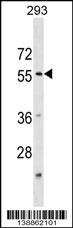
KATNA1 Antibody (N-term) western blot analysis in 293 cell line lysates (35ug/lane).This demonstrates the KATNA1 antibody detected the KATNA1 protein (arrow).| Product Name | KATNA1 Antibody (N-term) |
|---|---|
| Antibody Type | Primary Antibodies |
| Antigen Alias | KATNA1; Katanin p60 ATPase-containing subunit A1; p60 katanin |
| Clonality | Polyclonal |
|---|---|
| Isotype | Ig |
| Host Species | Rabbit |
| Tested Applications | WB |
| WB:1:100~500 |
|
| Species Reactivity | Human |
| Concentration | 1mg/ml |
| Alternative Names | KATNA1 Katanin p60 ATPase-containing subunit A1 p60 katanin |
|---|---|
| Molecular Weight(MW) | 55965 Da |
| Function | Catalytic subunit of a complex which severs microtubules in an ATP-dependent manner. Microtubule severing may promote rapid reorganization of cellular microtubule arrays and the release of microtubules from the centrosome following nucleation. Microtubule release from the mitotic spindle poles may allow depolymerization of the microtubule end proximal to the spindle pole, leading to poleward microtubule flux and poleward motion of chromosome Microtubule release within the cell body of neurons may be required for their transport into neuronal processes by microtubule-dependent motor proteins. This transport is required for axonal growth (By similarity) |
| Tissue Specificity | This KATNA1 antibody is generated from rabbits immunized with a KLH conjugated synthetic between 58-85 amino acids selected from the N-terminal region of human KATNA1. |
| Cellular Localization | Cytoplasm. Cytoplasm, cytoskeleton, centrosome. Cytoplasm, cytoskeleton, spindle. Cytoplasm, cytoskeleton, spindle pole. Midbody. Cytoplasm, cytoskeleton Note=Predominantly cytoplasmic. Localized diffusely in the cytoplasm during the interphase. During metaphase is localized throughout the cell and more widely dispersed than the microtubules. In anaphase and telophase is localized at the midbody region. Also localized to the interphase centrosome and the mitotic spindle poles. Enhanced recruitment to the mitotic spindle poles requires microtubules and interaction with KATNB1 |
| Entrez Gene | 11104 |
|---|---|
| Nucleotide Accession | NP_008975.1 |
Application
KATNA1 Antibody (N-term) western blot analysis in 293 cell line lysates (35ug/lane).This demonstrates the KATNA1 antibody detected the KATNA1 protein (arrow).| Application Notes | WB:1:100~500 |
|---|
| Form | Liquid |
|---|---|
| Storage Instructions | For short-term storage, store at 4° C. For long-term storage, aliquot and store at -20ºC or below. Avoid multiple freeze-thaw cycles. |
| Storage Buffer | Purified polyclonal antibody supplied in PBS with 0.09% (W/V) sodium azide. This antibody is purified through a protein A column, followed by peptide affinity purification. |


