Application
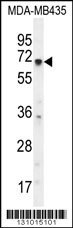
KCNQ1 Antibody (N-term) western blot analysis in MDA-MB435 cell line lysates (35ug/lane).This demonstrates the KCNQ1 antibody detected the KCNQ1 protein (arrow).| Product Name | KCNQ1 Antibody (N-term) |
|---|---|
| Antibody Type | Primary Antibodies |
| Antigen Alias | KCNQ1; KCNA8; KCNA9; KVLQT1; Potassium voltage-gated channel subfamily KQT member 1; IKs producing slow voltage-gated potassium channel subunit alpha KvLQT1; KQT-like 1; Voltage-gated potassium channel subunit Kv7.1 |
| Clonality | Polyclonal |
|---|---|
| Isotype | Ig |
| Host Species | Rabbit |
| Tested Applications | WB |
| WB:1:100~500 |
|
| Species Reactivity | Human |
| Concentration | 1mg/ml |
| Gene Synonyms | KCNA8 KCNA9 KVLQT1 |
|---|---|
| Alternative Names | KCNQ1 KCNA8 KCNA9 KVLQT1 Potassium voltage-gated channel subfamily KQT member 1 IKs producing slow voltage-gated potassium channel subunit alpha KvLQT1 KQT-like 1 Voltage-gated potassium channel subunit Kv7.1 |
| Molecular Weight(MW) | 74699 Da |
| Function | Probably important in cardiac repolarization. Associates with KCNE1 (MinK) to form the I(Ks) cardiac potassium current Elicits a rapidly activating, potassium-selective outward current Muscarinic agonist oxotremorine-M strongly suppresses KCNQ1/KCNE1 current in CHO cells in which cloned KCNQ1/KCNE1 channels were coexpressed with M1 muscarinic receptors. May associate also with KCNE3 (MiRP2) to form the potassium channel that is important for cyclic AMP-stimulated intestinal secretion of chloride ions, which is reduced in cystic fibrosis and pathologically stimulated in cholera and other forms of secretory diarrhea |
| Tissue Specificity | Abundantly expressed in heart, pancreas, prostate, kidney, small intestine and peripheral blood leukocytes Less abundant in placenta, lung, spleen, colon, thymus, testis and ovaries |
| Cellular Localization | Cell membrane; Multi-pass membrane protein. Cytoplasmic vesicle membrane; Multi-pass membrane protein |
| Entrez Gene | 3784 |
|---|---|
| Nucleotide Accession | NP_000209.2 NP_861463.1 |
Application
KCNQ1 Antibody (N-term) western blot analysis in MDA-MB435 cell line lysates (35ug/lane).This demonstrates the KCNQ1 antibody detected the KCNQ1 protein (arrow).| Application Notes | WB:1:100~500 |
|---|
| Form | Liquid |
|---|---|
| Storage Instructions | For short-term storage, store at 4° C. For long-term storage, aliquot and store at -20ºC or below. Avoid multiple freeze-thaw cycles. |
| Storage Buffer | Purified polyclonal antibody supplied in PBS with 0.09% (W/V) sodium azide. This antibody is purified through a protein A column, followed by peptide affinity purification. |


