Application
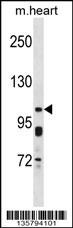
KCNQ5 Antibody (C-term) western blot analysis in mouse heart tissue lysates (35ug/lane).This demonstrates the KCNQ5 antibody detected the KCNQ5 protein (arrow).| Product Name | KCNQ5 Antibody (C-term) |
|---|---|
| Antibody Type | Primary Antibodies |
| Antigen Alias | KCNQ5; Potassium voltage-gated channel subfamily KQT member 5; KQT-like 5; Potassium channel subunit alpha KvLQT5; Voltage-gated potassium channel subunit Kv7.5 |
| Clonality | Polyclonal |
|---|---|
| Isotype | Ig |
| Host Species | Rabbit |
| Tested Applications | WB |
| WB:1:100~500 |
|
| Species Reactivity | Human |
| Concentration | 1mg/ml |
| Alternative Names | KCNQ5 Potassium voltage-gated channel subfamily KQT member 5 KQT-like 5 Potassium channel subunit alpha KvLQT5 Voltage-gated potassium channel subunit Kv7.5 |
|---|---|
| Molecular Weight(MW) | 102179 Da |
| Function | Probably important in the regulation of neuronal excitability. Associates with KCNQ3 to form a potassium channel which contributes to M-type current, a slowly activating and deactivating potassium conductance which plays a critical role in determining the subthreshold electrical excitability of neurons May contribute, with other potassium channels, to the molecular diversity of a heterogeneous population of M-channels, varying in kinetic and pharmacological properties, which underlie this physiologically important current. Insensitive to tetraethylammonium, but inhibited by barium, linopirdine and XE991. Activated by niflumic acid and the anticonvulsant retigabine. Muscarine suppresses KCNQ5 current in Xenopus oocytes in which cloned KCNQ5 channels were coexpressed with M(1) muscarinic receptors |
| Tissue Specificity | Strongly expressed in brain and skeletal muscle. In brain, expressed in cerebral cortex, occipital pole, frontal lobe and temporal lobe. Lower levels in hippocampus and putamen. Low to undetectable levels in medulla, cerebellum and thalamus |
| Cellular Localization | Membrane; Multi-pass membrane protein. |
| Entrez Gene | 56479 |
|---|---|
| Nucleotide Accession | NP_001153602.1 NP_001153604.1 |
Application
KCNQ5 Antibody (C-term) western blot analysis in mouse heart tissue lysates (35ug/lane).This demonstrates the KCNQ5 antibody detected the KCNQ5 protein (arrow).| Application Notes | WB:1:100~500 |
|---|
| Form | Liquid |
|---|---|
| Storage Instructions | For short-term storage, store at 4° C. For long-term storage, aliquot and store at -20ºC or below. Avoid multiple freeze-thaw cycles. |
| Storage Buffer | Purified polyclonal antibody supplied in PBS with 0.09% (W/V) sodium azide. This antibody is purified through a protein A column, followed by peptide affinity purification. |


