Application
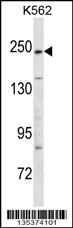
KIDINS220 Antibody (C-term) western blot analysis in K562 cell line lysates (35ug/lane).This demonstrates the KIDINS220 antibody detected the KIDINS220 protein (arrow).| Product Name | KIDINS220 Antibody (C-term) |
|---|---|
| Antibody Type | Primary Antibodies |
| Antigen Alias | KIDINS220; ARMS; KIAA1250; Kinase D-interacting substrate of 220 kDa; Ankyrin repeat-rich membrane-spanning protein |
| Clonality | Polyclonal |
|---|---|
| Isotype | Ig |
| Host Species | Rabbit |
| Tested Applications | WB |
| WB:1:100~500 |
|
| Species Reactivity | Human |
| Concentration | 1mg/ml |
| Gene Synonyms | ARMS KIAA1250 |
|---|---|
| Alternative Names | KIDINS220 ARMS KIAA1250 Kinase D-interacting substrate of 220 kDa Ankyrin repeat-rich membrane-spanning protein |
| Molecular Weight(MW) | 196542 Da |
| Function | Promotes a prolonged MAP-kinase signaling by neurotrophins through activation of a Rap1-dependent mechanism Provides a docking site for the CRKL-C3G complex, resulting in Rap1-dependent sustained ERK activation. May play an important role in regulating postsynaptic signal transduction through the syntrophin-mediated localization of receptor tyrosine kinases such as EPHA4. In cooperation with SNTA1 can enhance EPHA4-induced JAK/STAT activation. May play a role in neurotrophin- and ephrin- mediated neuronal outgrowth and in axon guidance during neural development and in neuronal regeneration (By similarity) Modulates stress-induced apoptosis of melanoma cells via regulation of the MEK/ERK signaling pathway |
| Tissue Specificity | Abundant in developing and adult neural tissues as well as neuroendocrine cells and dendritic cells Overexpressed in melanoma and melanoma cell lines |
| Cellular Localization | Membrane; Multi-pass membrane protein (Potential) |
| Entrez Gene | 57498 |
|---|---|
| Nucleotide Accession | NP_065789.1 |
Application
KIDINS220 Antibody (C-term) western blot analysis in K562 cell line lysates (35ug/lane).This demonstrates the KIDINS220 antibody detected the KIDINS220 protein (arrow).| Application Notes | WB:1:100~500 |
|---|
| Form | Liquid |
|---|---|
| Storage Instructions | For short-term storage, store at 4° C. For long-term storage, aliquot and store at -20ºC or below. Avoid multiple freeze-thaw cycles. |
| Storage Buffer | Purified polyclonal antibody supplied in PBS with 0.09% (W/V) sodium azide. This antibody is purified through a protein A column, followed by peptide affinity purification. |


