Application
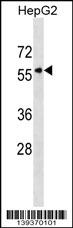
KPNA5 Antibody (N-term) western blot analysis in HepG2 cell line lysates (35ug/lane).This demonstrates the KPNA5 antibody detected the KPNA5 protein (arrow).| Product Name | KPNA5 Antibody (N-term) |
|---|---|
| Antibody Type | Primary Antibodies |
| Antigen Alias | KPNA5; Importin subunit alpha-6; Karyopherin subunit alpha-5 |
| Clonality | Polyclonal |
|---|---|
| Isotype | Ig |
| Host Species | Rabbit |
| Tested Applications | WB |
| WB:1:100~500 |
|
| Species Reactivity | Human |
| Concentration | 1mg/ml |
| Alternative Names | KPNA5 Importin subunit alpha-6 Karyopherin subunit alpha-5 |
|---|---|
| Molecular Weight(MW) | 60349 Da |
| Function | Functions in nuclear protein import as an adapter protein for nuclear receptor KPNB1. Binds specifically and directly to substrates containing either a simple or bipartite NLS motif. Docking of the importin/substrate complex to the nuclear pore complex (NPC) is mediated by KPNB1 through binding to nucleoporin FxFG repeats and the complex is subsequently translocated through the pore by an energy requiring, Ran- dependent mechanism. At the nucleoplasmic side of the NPC, Ran binds to importin-beta and the three components separate and importin-alpha and -beta are re-exported from the nucleus to the cytoplasm where GTP hydrolysis releases Ran from importin. The directionality of nuclear import is thought to be conferred by an asymmetric distribution of the GTP- and GDP-bound forms of Ran between the cytoplasm and nucleus. Mediates nuclear import of STAT1 homodimers and STAT1/STAT2 heterodimers by recognizing non- classical NLSs of STAT1 and STAT2 through ARM repeats 8-9 Recognizes influenza A virus nucleoprotein through ARM repeat 7-9 In vitro, mediates the nuclear import of human cytomegalovirus UL84 by recognizing a non-classical NLS |
| Tissue Specificity | Testis. |
| Cellular Localization | Cytoplasm. |
| Entrez Gene | 3841 |
|---|---|
| Nucleotide Accession | NP_002260.2 |
Application
KPNA5 Antibody (N-term) western blot analysis in HepG2 cell line lysates (35ug/lane).This demonstrates the KPNA5 antibody detected the KPNA5 protein (arrow).| Application Notes | WB:1:100~500 |
|---|
| Form | Liquid |
|---|---|
| Storage Instructions | For short-term storage, store at 4° C. For long-term storage, aliquot and store at -20ºC or below. Avoid multiple freeze-thaw cycles. |
| Storage Buffer | Purified polyclonal antibody supplied in PBS with 0.09% (W/V) sodium azide. This antibody is purified through a protein A column, followed by peptide affinity purification. |


