Application
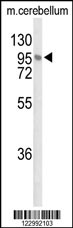
Western blot analysis of LINGO1 Antibody (N-term) in mouse cerebellum tissue lysates (35ug/lane). LINGO1 (arrow) was detected using the purified Pab.| Product Name | LINGO1 Antibody (N-term) |
|---|---|
| Antibody Type | Primary Antibodies |
| Antigen Alias | LINGO1; LERN1; LRRN6A; Leucine-rich repeat and immunoglobulin-like domain-containing nogo receptor-interacting protein 1; Leucine-rich repeat and immunoglobilin domain-containing protein 1; Leucine-rich repeat neuronal protein 1; Leucine-rich repeat neuron |
| Clonality | Polyclonal |
|---|---|
| Isotype | Ig |
| Host Species | Rabbit |
| Tested Applications | WB |
| WB:1:100~500 |
|
| Species Reactivity | Human |
| Concentration | 1mg/ml |
| Gene Synonyms | LERN1 LRRN6A |
|---|---|
| Alternative Names | LINGO1 LERN1 LRRN6A Leucine-rich repeat and immunoglobulin-like domain-containing nogo receptor-interacting protein 1 Leucine-rich repeat and immunoglobilin domain-containing protein 1 Leucine-rich repeat neuronal protein 1 Leucine-rich repeat neuron |
| Molecular Weight(MW) | 69876 Da |
| Function | Functional component of the Nogo receptor signaling complex (RTN4R/NGFR) in RhoA activation responsible for some inhibition of axonal regeneration by myelin-associated factors. Is also an important negative regulator of oligodentrocyte differentiation and axonal myelination. Acts in conjunction with RTN4 and RTN4R in regulating neuronal precursor cell motility during cortical development (By similarity) |
| Tissue Specificity | Expressed exclusively in the central nervous system. Highest level in the in amygdala, hippocampus, thalamus and cerebral cortex. In the rest of the brain a basal expression seems to be always present. Up-regulated in substantia nigra neurons from Parkinson disease patients |
| Cellular Localization | Cell membrane; Single-pass type I membrane protein (By similarity) |
| Entrez Gene | 84894 |
|---|
Application
Western blot analysis of LINGO1 Antibody (N-term) in mouse cerebellum tissue lysates (35ug/lane). LINGO1 (arrow) was detected using the purified Pab.| Application Notes | WB:1:100~500 |
|---|
| Form | Liquid |
|---|---|
| Storage Instructions | For short-term storage, store at 4° C. For long-term storage, aliquot and store at -20ºC or below. Avoid multiple freeze-thaw cycles. |
| Storage Buffer | Purified polyclonal antibody supplied in PBS with 0.09% (W/V) sodium azide. This antibody is purified through a protein A column, followed by peptide affinity purification. |


