Application
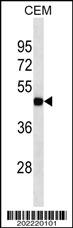
LPL Antibody (Ascites)(Cat. #AM2104a) western blot analysis in CEM cell line lysates (35ug/lane).This demonstrates the LPL antibody detected the LPL protein (arrow).| Product Name | LPL Antibody (Ascites) |
|---|---|
| Antibody Type | Primary Antibodies |
| Clonality | Monoclonal |
|---|---|
| Isotype | IgM |
| Clone Number | 586CT15.2.2 |
| Host Species | Mouse |
| Tested Applications | WB |
| WB:1:100~800 |
|
| Species Reactivity | Human |
| Concentration | 1mg/ml |
| Gene Synonyms | LIPD |
|---|---|
| Alternative Names | LPL LIPD Lipoprotein lipase |
| Molecular Weight(MW) | 53162 Da |
| Function | The primary function of this lipase is the hydrolysis of triglycerides of circulating chylomicrons and very low density lipoproteins (VLDL). Binding to heparin sulfate proteogylcans at the cell surface is vital to the function. The apolipoprotein, APOC2, acts as a coactivator of LPL activity in the presence of lipids on the luminal surface of vascular endothelium (By similarity) |
| Tissue Specificity | This LPL Monoclonal antibody is generated from mouses immunized with a KLH conjugated synthetic peptide selected from human LPL. |
| Cellular Localization | Cell membrane (By similarity); Lipid-anchor, GPI-anchor (By similarity). Secreted (By similarity). Note=Locates to the plasma membrane of microvilli of hepatocytes with triacyl- glycerol-rich lipoproteins (TRL). Some of the bound LPL is then internalized and located inside non-coated endocytic vesicles (By similarity) |
Application
LPL Antibody (Ascites)(Cat. #AM2104a) western blot analysis in CEM cell line lysates (35ug/lane).This demonstrates the LPL antibody detected the LPL protein (arrow).| Application Notes | WB:1:100~800 |
|---|
| Form | Liquid |
|---|---|
| Storage Instructions | For short-term storage, store at 4° C. For long-term storage, aliquot and store at -20ºC or below. Avoid multiple freeze-thaw cycles. |
| Storage Buffer | Mouse monoclonal antibody supplied in crude ascites with 0.09% (W/V) sodium azide. |


