Application
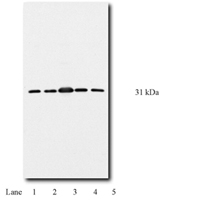
At right is a typical western blot (10% SDS-PAGE) of 3T3 (lane 1), PC12 (lane 2), MDBK (lane 3), Jurkat (lane 4) and normal human fibroblasts (lane 5).| Product Name | 14-3-3 theta/tau antibody |
|---|---|
| Antibody Type | Primary Antibodies |
| Product description | Mouse monoclonal [3B9] to 14-3-3 theta/tauAt least seven isoforms comprise the highly conserved 14-3-3 family of homo and heterodimeric proteins that are abundantly expressed in all eukaryotic cells. These multifunctional proteins bind and modulate the function of a wide array of cellular proteins. They exist mainly as dimers with a monomeric molecular mass of approximately 30 kDa and have an acidic isoelectric point of 4.5-5. Although more than seven isoforms of 14-3-3 have been described, some redundancies have appeared upon sequencing. The 14-3-3s are thought to be key regulators of signal transduction events mediated through their binding to serine-phosphorylated proteins. By interacting with Cdc25C, 14-3-3 regulates entry into the cell cycle and through interaction with bad, prevents apoptosis. 14-3-3 plays a dual role in Raf-1 activation. It helps to keep Raf-1 in an inactive state by binding to phophoserine-259 and the cysteine-rich domain (DRD). Interactions of 14-3-3 at the phosphoserine-621 may be required for Raf1 activation and may function as an essential cofactor for Raf1 kinase activity. Other proteins that have been shown to bind 14-3-3s include members of the protein kinase C family, Cbl, IRS1, middle-T antigen, KSR, IGF1 receptor, etc. Detection of 14-3-3 proteins in cerebrospinal fluid has been shown to be quite useful in the differential diagnosis of Creutzfeldt-Jakob disease and other prion diseases. The theta or tau isoform was initially isolated from T cells. It's structure has been resolved. It is found in T cells, brain and testes. Although the zeta isoform is present at high levels, beta, gamma, tau and eta isoforms are also expressed in the rat brain. However, the tau isoform is the only isoform found in the white matter. |
| Immunogen | Recombinant full length protein. |
| Clonality | Monoclonal |
|---|---|
| Isotype | IgG1 |
| Clone Number | 3B9 |
| Host Species | Mouse |
| Tested Applications | IPWB |
| For IP: Use at an assay dependent dilution. For WB: Use at a dilution of 1:5,000. Detects a band of approximately 31 kDa. Optimal dilutions/concentrations should be determined by the researcher.: |
|
| Species Reactivity | HumanMouseRatBovine |
| Concentration | 1mg/ml (Please refer to the vial label for the specific concentration) |
| Purification | Protein G |
| Gene Synonyms | 609009 10971 1C5 1433 theta/tau 1433 P27348 HS1 YWHAQ 2014/3/3 |
|---|---|
| Target | 14-3-3 theta/tau |
Application
At right is a typical western blot (10% SDS-PAGE) of 3T3 (lane 1), PC12 (lane 2), MDBK (lane 3), Jurkat (lane 4) and normal human fibroblasts (lane 5).| Positive Control | 3T3, PC12, and Jurkat |
|---|---|
| Application Notes | For IP: Use at an assay dependent dilution. For WB: Use at a dilution of 1:5,000. Detects a band of approximately 31 kDa. Optimal dilutions/concentrations should be determined by the researcher.: |
| Form | Liquid |
|---|---|
| Storage Instructions | Upon Receipt - Keep as concentrated solution. Aliquot and store at -20ºC or below. Avoid freeze-thaw cycles. |
| Storage Buffer | 20 mM sodium phosphate, 150 mM sodium chloride, 50% Glycerol,pH 7.5 |


