Application
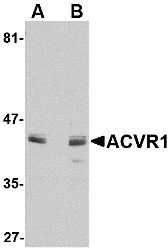
Western blot analysis of ACVR1 in A549 cell lysate with ACVR1 antibody at 1 ug/mL in (A) the absence and (B) the presence of blocking peptide.| Product Name | Activin A Receptor type I antibody |
|---|---|
| Antibody Type | Primary Antibodies |
| Product description | Rabbit Polyclonal antibody to Activin A Receptor type IActivins are dimeric growth and differentiation factors which belong to the transforming growth factor-beta (TGF-beta) superfamily of structurally related signaling proteins. Activins signal through a heteromeric complex of receptor serine kinases which include at least two type I ( I and IB) and two type II (II and IIB) receptors. These receptors are all transmembrane proteins, composed of a ligand-binding extracellular domain with cysteine-rich region, a transmembrane domain, and a cytoplasmic domain with predicted serine/threonine specificity. Type I receptors are essential for signaling; and type II receptors are required for binding ligands and for expression of type I receptors. Type I and II receptors form a stable complex after ligand binding, resulting in phosphorylation of type I receptors by type II receptors. This gene encodes activin A type I receptor which signals a particular transcriptional response in concert with activin type II receptors. Mutations in this gene are associated with fibrodysplasia ossificans progressive. [provided by RefSeq, Jul 2008] |
| Immunogen | ACVR1 antibody was raised against a 14 amino acid synthetic peptide near the amino terminus of the human ACVR1. |
| Clonality | Polyclonal |
|---|---|
| Isotype | IgG |
| Host Species | Rabbit |
| Tested Applications | ELISAWB |
| WB: 1 ug/ml: |
|
| Species Reactivity | Human |
| Concentration | 1mg/ml (Please refer to the vial label for the specific concentration) |
| Purification | Affinity purified |
| Gene Synonyms | ACVR1A ACVRLK2 FOP SKR1 TSRI ACVR1 activin A receptor type I ACTRI ALK2 |
|---|---|
| Target | Activin A Receptor type I |
| Tissue Specificity | At least four isoforms of ACVR1 are known to exist. This antibody is predicted to have no cross-reactivity to ACVR1B or ACVR1C. |
Application
Western blot analysis of ACVR1 in A549 cell lysate with ACVR1 antibody at 1 ug/mL in (A) the absence and (B) the presence of blocking peptide.| Application Notes | WB: 1 ug/ml: |
|---|
| Form | Liquid |
|---|---|
| Storage Instructions | Be stored at 4oC for three months and -20oC, stable for up to one year. As with all antibodies care should be taken to avoid repeated freeze thaw cycles. Antibodies should not be exposed to prolonged high temperatures. |
| Storage Buffer | PBS containing 0.02% sodium azide. |


